

In this story
Last updated: November 10, 2026
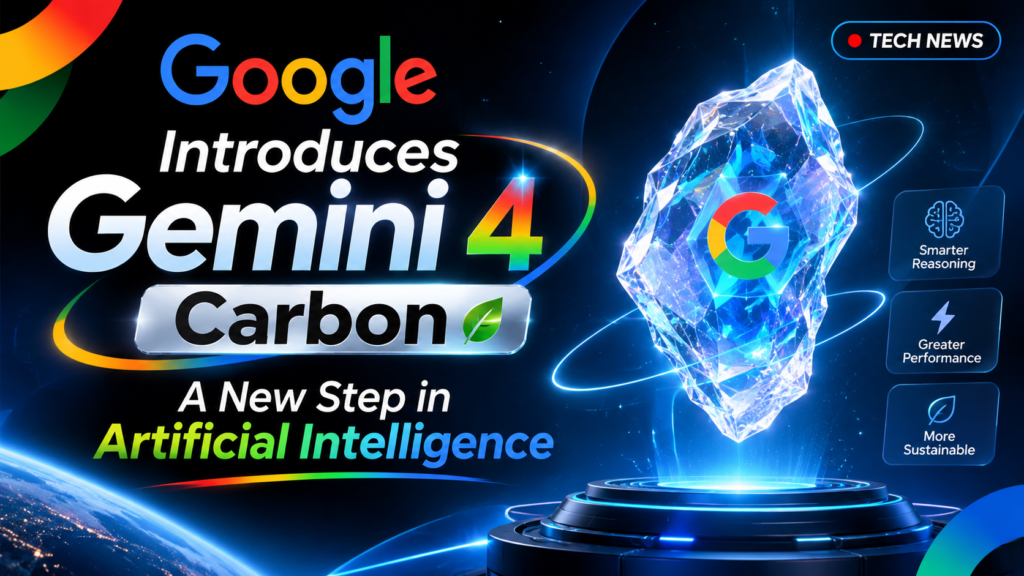
Google has taken another major step in artificial intelligence with the wider release of Gemini 4 Carbon, its latest frontier AI model. First announced on October 28, Carbon initially reached a limited group of cybersecurity defenders. Now, Google is expanding access to developers, businesses, and selected consumer subscribers.
The new model focuses on difficult problems that require deeper reasoning, multiple steps, and long-running tasks. Google describes Carbon as its strongest model, built to handle demanding engineering work, advanced coding, cybersecurity, and scientific research.
However, Carbon is not simply another chatbot update. Its main goal is to work through complex tasks for longer, investigate problems, and help users complete projects that may require several stages of reasoning.
In this article, we explore what Gemini 4 Carbon offers, how it performs in independent and cybersecurity benchmarks, who can use it, and how much it costs.
What Is Gemini 4 Carbon?
Gemini 4 Carbon is Google’s advanced artificial intelligence model, developed to handle complex tasks that need more than a quick answer. It builds on Gemini 4 Argon but targets harder problems that require extended reasoning and sustained work.
For example, a developer might ask Carbon to investigate a difficult software bug, examine a large codebase, identify the cause of a security problem, and suggest a possible fix. Instead of treating every step as a separate question, Carbon aims to work through the process as one connected task.
Google also highlights its ability to support long-running agentic workflows. This means the model can plan, use tools, review results, and continue working through several stages.
Google explains the difference between its two models in a simple way: Argon is suitable for many complex tasks, while Carbon is designed for the hardest problems.
This makes Carbon particularly interesting for software engineers, cybersecurity teams, researchers, and businesses that need advanced AI support.
Gemini 4 Carbon: Main Features at a Glance
Here are some of the main capabilities Google highlights:
| Feature | What it means |
|---|---|
| Advanced reasoning | Works through difficult questions and multi-step problems |
| Long-horizon tasks | Handles projects that require extended work |
| AI coding | Helps investigate bugs and develop software solutions |
| Cybersecurity | Supports vulnerability detection, validation, and remediation |
| Agentic workflows | Can work through connected tasks using tools |
| Scientific research | Supports demanding research and technical problem-solving |
| Web development | Improves the quality of generated websites and development work |
These features make Gemini 4 Carbon more suitable for demanding professional tasks than simple everyday questions.
Gemini 4 Carbon Benchmark Results
One of the most interesting parts of Google’s announcement is Carbon’s performance in independent and cybersecurity benchmarks.
According to Google and Artificial Analysis, Gemini 4 Carbon reached the top position on the Artificial Analysis Intelligence Index v5.0, with a score of 59.
The model also achieved strong results in three cybersecurity evaluations.
| Benchmark | What it measures | Gemini 4 Carbon |
|---|---|---|
| Artificial Analysis Intelligence Index v5.0 | Overall AI intelligence performance | 59 |
| SEC-bench Pro | Finding real software vulnerabilities | 88.2% |
| ExploitGym | Testing whether vulnerabilities can be exploited | 54.8% |
| CWE-bench | Identifying and fixing software weaknesses | 71.0% |
These results show why Google is positioning Carbon as a model for advanced engineering and cybersecurity work.
However, benchmark scores do not tell the whole story. Different tests measure different abilities, and a high score does not guarantee that an AI model will perform perfectly in real-world situations.
It is also important to remember that some of the cybersecurity results were evaluated without guardrails. Real-world performance may differ depending on the tools, safety restrictions, and working environment.
For a wider look at the results, readers can visit Artificial Analysis.
How Gemini 4 Carbon Can Help With Cybersecurity
Cybersecurity is one of the main areas where Google wants to use Gemini 4 Carbon.
Today, software teams face many challenges. Some security problems hide deep inside large codebases, while others require several steps to investigate and fix. Finding a vulnerability is only the beginning. Teams must also understand its impact, confirm whether attackers can exploit it, and develop a reliable solution.
Google says Carbon can support this process through three important capabilities.
1. Finding Software Vulnerabilities
Carbon achieved 88.2% on SEC-bench Pro, a benchmark that evaluates how well AI systems identify vulnerabilities in real-world software.
This ability could help security teams examine complex code and find weaknesses that developers might otherwise overlook.
2. Checking Whether a Vulnerability Is Exploitable
Not every software weakness creates the same level of risk. Security teams need to understand whether an attacker could actually use a vulnerability.
Carbon scored 54.8% on ExploitGym, which evaluates the model’s ability to validate vulnerabilities through exploitation tasks.
This can help professionals understand which issues deserve attention first. Of course, security specialists still need to review the results and follow responsible testing practices.
3. Helping Developers Fix Security Problems
Finding a vulnerability is useful, but fixing its root cause is even more important.
Carbon reached 71.0% on CWE-bench, which evaluates vulnerability remediation. Google also reports that Carbon achieved more than twice Argon’s success rate at generating secure code on its internal benchmark.
These results suggest that Carbon could become a useful assistant for developers who want to improve software security.
Gemini 4 Carbon and Long-Horizon AI Tasks
One of the biggest differences between Carbon and a typical AI chatbot is its focus on long-horizon work.
Many AI tools can answer questions, write short pieces of code, or summarize documents. However, some professional projects require much more. A developer might need to investigate a problem, test several possible solutions, review the results, and improve the final code.
Carbon is designed to support this kind of connected workflow.
Google says its internal teams have used the model for complex engineering tasks that can continue for days. These tasks include finding subtle bugs across large codebases and working on low-level systems.
This approach is part of a wider movement toward agentic AI. Instead of only responding to prompts, AI agents can plan tasks, use tools, and work through a sequence of actions.
For developers and businesses, this could make AI more useful in real projects. However, long-running tasks still need proper supervision, testing, and human review.
Gemini 4 Carbon Availability: Where Can You Use It Now?
Updated November 10, 2026
Google first introduced Gemini 4 Carbon through a limited rollout for selected cybersecurity defenders and trusted partners in its Fairwind Program.
On November 10, Google expanded access beyond that initial group.
According to the latest rollout information, Carbon is now available through several Google products:
| Platform | Who can access it? |
|---|---|
| Gemini API through Google AI Studio | Paying developers in supported countries and territories |
| Gemini for business | Paying business and enterprise customers |
| Gemini app | Google AI Ultra subscribers |
| AI Mode in Google Search | Google AI Ultra subscribers |
| Google Antigravity | Paying developers and enterprises, with access also included for Google AI Ultra subscribers |
Availability can depend on the product, subscription, and supported country. Google has not confirmed that Carbon is available to every free Gemini user or every subscription tier.
Developers can explore the model through Google AI Studio and the Gemini API.
Users can also check Google’s official Gemini models page for product updates and access information.
What About the Fairwind Program?
The Fairwind Program remains important because it gives selected cybersecurity defenders and trusted partners access to advanced AI capabilities for security work.
Google initially used this program to test Carbon with a limited group before expanding availability. This approach allows the company to gather feedback and improve safeguards while making the model available to more users.
How Much Does Gemini 4 Carbon Cost?
Google introduced Gemini 4 Carbon with the same introductory API pricing as Gemini 4 Argon.
The announced prices are:
| API usage | Introductory price | Later price |
|---|---|---|
| Input tokens | $2 per 1 million | $4 per 1 million |
| Output tokens | $10 per 1 million | $20 per 1 million |
| Cached input tokens | 95% discount | Check current API pricing |
The introductory rates are scheduled to end on November 30, 2026, with the higher rates applying afterward, according to coverage of the rollout.
For developers, this pricing matters because AI projects can use large numbers of tokens. However, the cheapest price per token does not always mean the lowest total cost. A model may need more tokens, additional attempts, or human corrections to finish a task.
Before using Carbon in a large project, developers should check the latest Google Gemini API pricing.
Gemini 4 Carbon vs Gemini 4 Argon: What Is the Difference?
Both models belong to Google’s Gemini 4 family, but they serve slightly different purposes.
Gemini 4 Argon focuses on complex everyday professional work, including software engineering and knowledge-based tasks. Carbon targets more demanding problems that require deeper reasoning and longer workflows.
| Category | Gemini 4 Argon | Gemini 4 Carbon |
|---|---|---|
| Main purpose | Complex professional tasks | The hardest, long-running tasks |
| Software engineering | Advanced coding support | More demanding engineering problems |
| Reasoning | Complex reasoning | Deeper multi-step reasoning |
| Cybersecurity | Advanced capabilities | Stronger focus on security research and defense |
| Long-running workflows | Supports complex tasks | Designed for sustained agentic work |
This does not mean Carbon must replace Argon in every situation. Google itself says Argon may remain the better choice for many software engineering and knowledge-work tasks.
The best choice depends on the complexity of the project, the available tools, and the cost of running the model.
What Does Gemini 4 Carbon Mean for the Future of AI?
The release of Gemini 4 Carbon shows how quickly AI development is moving beyond simple conversations.
Companies are now building models that can support complete workflows, not just generate text or answer isolated questions. This could change how developers build software, how businesses handle technical work, and how researchers explore difficult problems.
Cybersecurity is another important area. AI models may help teams find vulnerabilities earlier, understand security risks, and develop better fixes. However, these capabilities also require strong safeguards and responsible use.
Google’s wider release is an important step, but it is still too early to know how Carbon will perform across every industry and real-world situation.
The next stage will depend on how developers, businesses, and researchers use the model and how well it performs outside controlled benchmarks.
Final Thoughts
Gemini 4 Carbon is an important development in Google’s AI strategy. Its focus on advanced reasoning, long-horizon engineering, and cybersecurity makes it different from models designed mainly for everyday conversations.
Its benchmark results are impressive, and the November 10 rollout gives more developers and businesses an opportunity to explore its capabilities.
However, access depends on the product and subscription, and the introductory API pricing will not last forever. Users should also remember that benchmark results do not guarantee perfect performance.
For developers working on complex software projects, security research, or demanding technical tasks, Gemini 4 Carbon is a model worth watching.
As AI continues to develop, models that can plan, reason, and complete multi-step work may become an increasingly important part of the digital world.
Official Sources and Further Reading
For readers who want to explore the announcement, technical details, and current access options, here are useful sources:
- Google: Introducing Gemini 4 Carbon
- Google DeepMind: Gemini Models
- Artificial Analysis: Gemini 4 Carbon Model Profile
- Artificial Analysis: Gemini 4 Carbon Benchmark Analysis
- The Verge: Google Releases Gemini 4 Carbon to the Public
- VentureBeat: Gemini 4 Carbon Public Availability and Pricing
This article was updated on November 10, 2026, to include the wider Gemini 4 Carbon rollout and updated access information.




1 comment
Join the conversationMentioned elsewhere
Pingback: Claude Fable 5.2: Features, Pricing & Capabilities