
In this story
Published: November 11, 2026
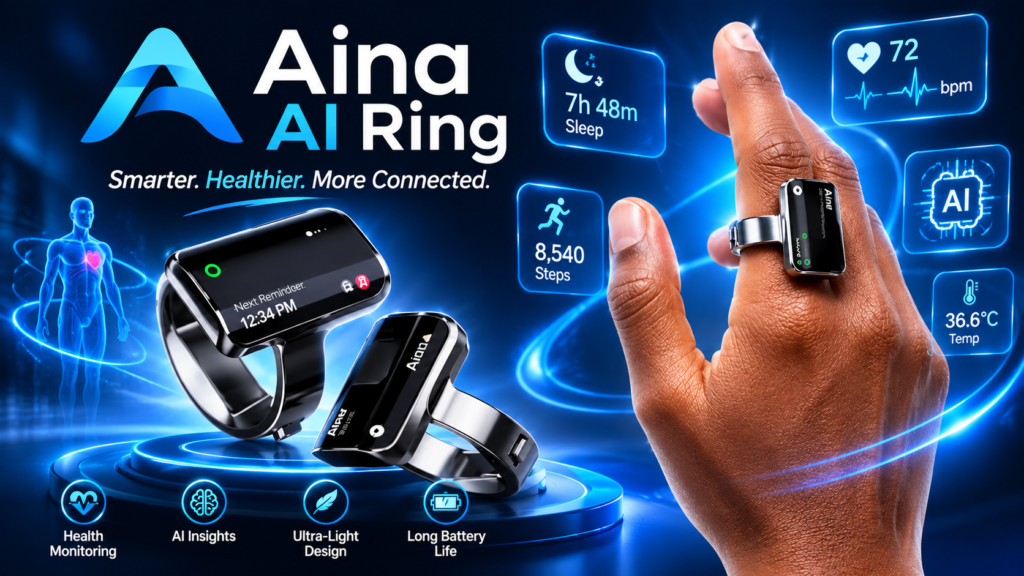
What if you could approve an AI assistant’s actions without unlocking your phone, opening an app, or touching your computer? That is the idea behind the Aina AI Ring, a new wearable device unveiled on November 5, 2026.
Unlike traditional smart rings that mainly focus on health and fitness tracking, Aina takes a different direction. It combines a small display, physical controls, a microphone, and a speaker to help people interact with AI agents and everyday digital devices.
The ring can show contextual suggestions, let users approve or reject actions, control meetings, manage music, and interact with connected devices. It also supports voice commands, so users can speak to their AI agents or capture notes with a simple button press.
But there is a bigger question behind this launch: Are smartphones becoming less important as artificial intelligence moves into wearable hardware?
In this article, we explore how the Aina AI Ring works, what makes it different, how much it costs, and whether this new type of wearable could change the way we use technology.
What Is the Aina AI Ring?
The Aina AI Ring is a smart wearable developed by Aina, a consumer hardware company working on new ways for people to interact with computers and artificial intelligence.
The company officially introduced the device on November 5, 2026, after spending more than a year developing its approach to human-computer interaction.
Its main purpose is simple: bring important digital actions closer to the user.
Instead of opening a smartphone every time an AI agent needs approval, the ring can display a suggestion directly on your finger. You can then use its physical controls to approve or reject the action.
For example, imagine you are getting ready for work. Your usual routine involves leaving home at 9 AM, checking your calendar, and booking a ride. Aina says its context-aware system can learn patterns from connected devices and surface a shortcut when it becomes relevant.
The company calls these suggestions Cues.
The idea is to make technology more proactive. Rather than asking users to search for every feature, Aina wants the device to bring useful actions forward at the right moment.
How Does the Aina AI Ring Work?
Aina combines a small screen, a physical button, gestures, voice interaction, and software that connects with supported devices.
The company describes three main ways to use the ring: Aina Cues, Aina Voice, and Aina Remote. It also includes controls for Mac applications and phone calls.
Here is how the main features work.
1. Aina Cues: Suggestions Before You Ask
Cues are one of the most interesting parts of the Aina AI Ring.
The system uses context from connected devices, including app usage patterns, location, calendar details, and connected agents, to suggest actions that may be useful.
For example:
- You are running late for a meeting, so the ring may suggest sending a message.
- It is almost time to leave for work, so it may surface a shortcut to book a ride.
- You have an upcoming task, so it can bring the relevant action closer to your attention.
The important difference is that Aina does not want users to search through several apps for every small action.
Instead, the ring shows a relevant suggestion, and the user can approve it with a gesture.
However, contextual suggestions must be accurate and useful. If a wearable constantly displays unnecessary notifications, people may stop paying attention to it.
2. Aina Voice: Talk to AI Agents
The second feature is voice interaction.
Users can hold the ring’s central button and speak to connected AI agents. They can also use voice commands to capture thoughts, create reminders, or request actions.
For example, you might say:
- Remind me about my meeting tomorrow.
- Book a ride home.
- Save this idea as a note.
- Dictate this message on my Mac.
The ring includes a microphone and speaker, which also allow users to make and receive phone calls.
This feature matters because voice can make AI interaction faster. Instead of typing a prompt on a small screen, users can speak naturally and receive a response through the device.
3. Aina Remote: Control Your Digital Devices
Aina Remote turns the ring into a controller for activities happening on connected devices.
For example, it can help users:
- Control music playback.
- Manage meeting controls.
- Adjust volume.
- Interact with supported smart-home devices.
- Control certain activities on a Mac or phone.
The ring can adapt its controls to the activity. During a meeting, it can surface meeting-related actions. When music is playing, it can offer music controls.
This is an interesting approach because the same small device can serve different purposes throughout the day.
4. Mac Controls and Phone Calls
Aina also focuses on people who spend much of their day working on computers.
The ring supports gestures for Mac applications, including meeting controls and voice dictation. Users can hold the button and speak to enter words on their Mac.
It can also show incoming calls and allow users to answer or decline them with a gesture.
These features make the ring more than a notification accessory. Aina wants it to become a physical controller for everyday digital activities.
Aina AI Ring Specifications: What Is Inside?
The device includes several hardware components designed to make interaction possible without a traditional touchscreen.
Here is what Aina has officially shared:
| Specification | Details |
|---|---|
| Display | Small OLED display |
| Body material | Titanium components |
| Physical control | Side button with gesture navigation |
| Components | 140 |
| Microphone | Yes |
| Speaker | Yes |
| Water and dust resistance | IP65 |
| Available sizes | 7 to 13 |
| Finishes | Eclipse Black, Amber Gold, Mercury Silver, Slate Titanium |
| Charging | Dedicated charging dock |
| Supported devices | iPhone and Mac |
| Android support | Not supported |
| Windows support | Not supported |
One important detail is its IP65 rating. This means the ring is dust-tight and protected against water jets. However, Aina says users should remove it before swimming or showering.
The company also offers a sizing kit, which helps buyers choose the correct ring size before the device ships.
Battery-life information is not clearly listed in the published product specifications, so buyers should check for updated details before ordering.
Can the Aina AI Ring Replace Your Smartphone?
This is probably the most interesting question surrounding the product.
For years, smartphones have been the center of our digital lives. We use them to communicate, browse the internet, manage appointments, control smart devices, and access artificial intelligence tools.
However, AI agents are changing how people interact with software.
Instead of opening an application and completing every step manually, users can increasingly ask an AI agent to perform a task. The agent may prepare an action and then ask for approval.
This creates a new problem: if AI can handle more tasks automatically, do users still need to open their phones so often?
Aina believes that wearable hardware could make these interactions easier.
Why Smartphones Could Become Less Central
The Aina AI Ring offers a different way to interact with technology.
Consider a simple example. You receive a suggestion from an AI agent to send a message because you are running late. With a traditional interface, you might need to unlock your phone, open the relevant application, check the message, and confirm it.
With Aina, the suggestion can appear on the ring, allowing you to approve or reject it with a gesture.
That may sound like a small improvement, but people perform many quick digital actions every day.
If wearable devices can handle these interactions reliably, smartphones may become less necessary for certain routine tasks.
Why Smartphones Are Still Important
However, the Aina AI Ring does not replace everything a smartphone can do.
Its official product page currently lists support for iPhone and Mac, while Android and Windows are not supported.
Users still need their connected devices for setup, pairing, updates, and many everyday activities.
A ring also has a much smaller display than a smartphone. It is not designed for watching videos, browsing complex websites, editing documents, or managing every application.
For now, the more realistic future is a combination of devices:
- Smartphones remain important for larger tasks and detailed interactions.
- Computers handle professional work and complex applications.
- Wearables provide quick controls, notifications, and approvals.
- AI agents manage more tasks in the background.
In other words, smartphones may become less central to some interactions without disappearing from our daily lives.
Aina AI Ring Price and Availability
Aina opened pre-orders on November 5, 2026.
The company announced an early-access price of $399, with a regular listed price of $499 after the limited early-bird offer.
| Purchase detail | Information |
|---|---|
| Early-access price | $399 |
| Listed price | $499 |
| Pre-orders | Opened November 5, 2026 |
| Expected shipping | Early 2027 |
| Sizing kit | Free |
| Charging dock | Included |
| Travel charger | Optional, $29 |
The company says the sizing kit ships first. Buyers can try the available sizes at home and select the right fit through the Aina app.
The ring is currently designed to work with iPhone and Mac. Android and Windows users should be aware that these platforms are not supported according to the company’s published specifications.
You can check the latest price, ordering information, and supported features on the official Aina Ring website.
What Makes Aina Different From Traditional Smart Rings?
Many people know smart rings through products focused on sleep, fitness, activity, and health-related information.
Aina takes a different approach.
Its main focus is not presenting health information. Instead, it aims to create a new way to control AI agents, applications, computers, and connected devices.
| Traditional smart ring approach | Aina AI Ring |
|---|---|
| Often focuses on health and fitness | Focuses on AI and device interaction |
| Tracks selected body and activity data | Surfaces contextual digital suggestions |
| Usually relies on a companion app for information | Includes its own small display |
| Limited physical interaction | Includes a button and gesture controls |
| Health-related insights are a central feature | AI agents and everyday controls are central |
This does not mean every traditional smart ring works in exactly the same way. Different products have different features.
The interesting point is that Aina is exploring a new category: a wearable designed to control digital experiences rather than simply collect information about the wearer.
The Biggest Challenges Aina Must Solve
The idea is interesting, but a new device does not automatically become part of people’s daily routines.
Aina still needs to prove that its ring offers enough value to justify wearing and paying for another piece of technology.
1. Battery Life and Everyday Comfort
A ring needs to be comfortable because users may wear it for many hours.
Its screen, microphone, speaker, and other components also need power. Battery life will therefore be an important factor when independent users begin testing the product.
2. Privacy and Personal Data
Aina’s contextual system uses information from connected devices, including location and calendar details, to surface suggestions.
That makes privacy an important question.
Users should understand what information the system accesses, how it stores data, and whether they can control or disable specific permissions.
Before connecting personal accounts, buyers should review the company’s privacy policy.
3. Device Compatibility
At launch, Aina lists iPhone and Mac support, but not Android or Windows.
This limits the number of people who can use the ring with their existing devices.
Broader compatibility could become important if the company wants to reach users outside the Apple ecosystem.
4. Will People Actually Use It Every Day?
Aina wants to reduce the number of times people need to open their phones.
However, users will only adopt another wearable if it saves time and feels easier than existing controls.
If suggestions are inaccurate, gestures are difficult, or notifications become distracting, the ring may create more problems than it solves.
Real-world reviews and long-term testing will help answer these questions.
The Future of AI Wearables: From Asking to Approving
The Aina AI Ring is part of a broader change in digital technology.
AI tools are moving beyond simple question-and-answer experiences. More systems can now plan tasks, connect with applications, and take actions on behalf of users.
This creates a new need: a simple way to monitor what AI agents are doing and decide when they can proceed.
A small wearable could become useful in this situation.
Instead of opening a phone every time an agent needs permission, a user could receive a short notification and approve an action directly from a ring.
However, this future depends on trust. People need to know what an agent is doing, why it is suggesting an action, and what happens after approval.
The next generation of wearables may therefore focus less on adding more screens and more on creating simple, reliable ways to interact with intelligent software.
Aina is one example of this direction, but its success will depend on the actual experience after the product reaches more users.
Final Thoughts: Is the Smartphone Becoming Less Important?
The Aina AI Ring introduces an interesting idea: what if we did not need to open our phones for every small digital action?
Its display, voice controls, gestures, and contextual suggestions aim to make interaction with AI agents faster and more convenient.
However, it is too early to say that smartphones are becoming obsolete. Aina still depends on an iPhone and Mac, and it does not replace the larger screens and applications people use every day.
I think the most interesting possibility is not a world without smartphones. It is a world where people use several connected devices, and each one handles the type of interaction it does best.
The phone may remain important, but wearables like Aina could take over some of the small actions that currently keep us checking our screens.
The real test will begin when the Aina AI Ring reaches customers in early 2027. That is when we will see whether people genuinely want an AI controller on their finger or whether the smartphone remains the most convenient interface.
Official Sources and Further Reading
- Aina’s Original Launch Announcement – November 5, 2026
- Aina Ring – Official Product Page, Features and Pricing
- TechCrunch – Aina’s Smart Ring Has a Screen, Joystick and Microphone
This article is based on Aina’s November 5, 2026 launch announcement and the company’s published product information. Pricing, specifications, compatibility, and shipping details may change.