
In this story
Published: November 9, 2026
Artificial intelligence is developing faster than ever, and technology companies are competing to build the infrastructure needed to support increasingly powerful AI systems.
Google has now announced two additions to its eighth-generation Tensor Processing Unit (TPU) portfolio: TPU 8tx and TPU 8i Max.
The announcement, published on November 9, 2026, expands Google’s eighth-generation portfolio to four specialized systems, following the earlier introduction of TPU 8t and TPU 8i.
But this announcement is about more than faster processors. Google’s latest systems are designed to address two important challenges in modern AI: protecting sensitive information while AI models work with it, and providing enough computing power and memory for AI agents handling increasingly complicated tasks.
Google also revealed something particularly interesting: its Gemini AI technology is helping engineers produce chip layouts in hours rather than weeks.
So, what makes these new systems different, and why does Google believe they are important for the future of artificial intelligence?
1. What Are Google’s New TPU 8tx and TPU 8i Max?
Before looking at the new systems, it is important to understand what a TPU actually is.
A Tensor Processing Unit (TPU) is a specialized processor developed by Google to accelerate artificial intelligence and machine learning workloads.
Unlike general-purpose processors designed to handle many different types of computing tasks, TPUs are specifically engineered for the mathematical operations commonly used in AI.
They help run and train large AI models, process information, and support services such as Google’s Gemini.
On November 9, Google expanded its eighth-generation TPU portfolio with two new systems:
- TPU 8tx: Designed for secure and confidential AI inference, particularly for organizations handling sensitive information.
- TPU 8i Max: Designed for massive context windows, increased computing capacity, and higher compute density per rack.
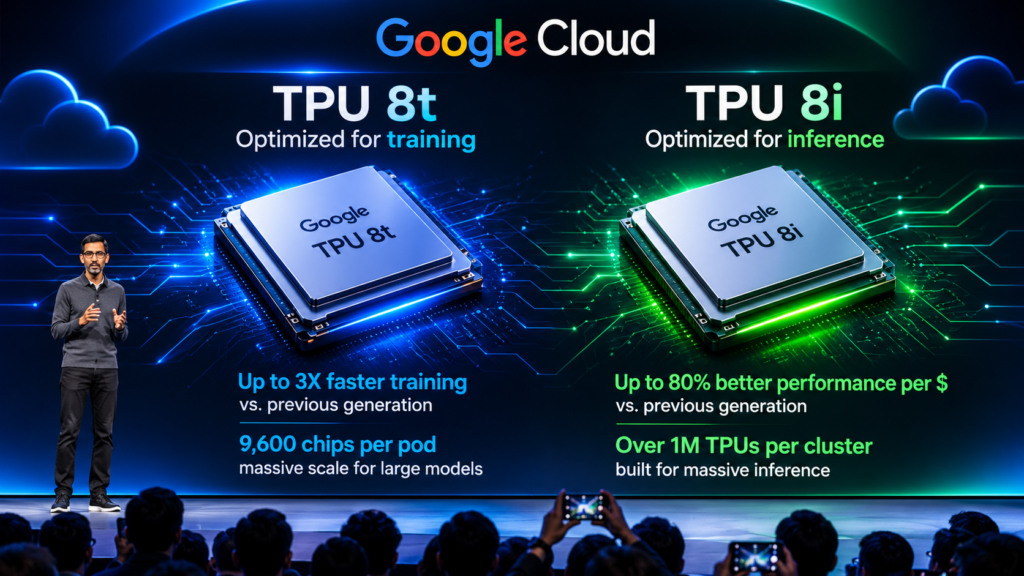
These systems join the previously introduced TPU 8t and TPU 8i.
Google says the four systems are designed to support different stages of the AI development and deployment process.
Official announcement: Google – Our Newest TPUs: 8tx and 8i Max.
2. TPU 8tx: Making AI More Secure for Businesses
One of the biggest challenges facing businesses adopting artificial intelligence is protecting sensitive information.
Companies in industries such as finance, healthcare, and government may need to process private information using AI systems.
However, protecting data while it is actively being processed can be more complicated than protecting files stored on a server or information transmitted across a network.
This is where TPU 8tx comes in.
Google designed this system specifically for secure and confidential AI inference.
What Makes TPU 8tx Different?
TPU 8tx introduces hardware-level confidential computing designed to protect sensitive data and AI model weights while they are being processed.
To understand why this matters, consider a business using an AI model to analyze confidential financial information.
The company needs the AI system to access the information and produce useful results without unnecessarily exposing sensitive data.
Google says TPU 8tx uses hardware-level security to isolate and protect data and model weights during active processing.
The system also uses Google’s low-latency networking architecture, helping AI agents complete multi-step operations efficiently.
According to Google, TPU 8tx can deliver up to twice the performance of TPU 8t in latency-sensitive workloads, with a near-zero performance penalty from its confidential computing design.
Who Could Benefit From TPU 8tx?
Some potential users include:
- Financial institutions processing confidential customer information.
- Government organizations working with sensitive data.
- Healthcare organizations handling private information.
- Businesses developing proprietary AI models.
- Enterprises deploying autonomous AI agents.
For these organizations, security is not simply an additional feature. It is an important requirement when introducing AI into existing business operations.
3. TPU 8i Max: Built for Massive AI Context Windows
While TPU 8tx focuses on security, TPU 8i Max addresses another important challenge: memory capacity and computing performance.
Modern AI systems increasingly need to process enormous amounts of information.
For example, imagine an AI agent analyzing an entire software project containing thousands of files, reviewing a lengthy technical document, or working with hours of video.
The more information an AI system needs to handle simultaneously, the greater the demands on its memory and computing infrastructure.
This challenge is sometimes described as the memory wall.
What Is the Memory Wall?
The memory wall occurs when a processor cannot receive information from memory quickly enough to keep its computing resources fully occupied.
In simple terms, the processor may be powerful, but it cannot work efficiently if the information it needs is not available quickly enough.
This becomes particularly important for AI agents that maintain large amounts of context while performing complex tasks.
Google designed TPU 8i Max to address this problem.
How Is TPU 8i Max Different?
Google combines two TPU 8i chips into a single package to increase computing and memory capabilities.
According to the announcement, TPU 8i Max provides:
- Twice the computing capacity of TPU 8i.
- Twice the SRAM.
- Twice the high-bandwidth memory bandwidth.
- Higher computing density within the existing rack footprint.
These improvements are intended to help AI systems process larger workloads without being slowed down as easily by memory limitations.
This could be particularly useful for advanced coding assistants, systems coordinating multiple AI agents, and applications that need to work with very large amounts of information.
4. Understanding the Four Systems in Google’s Eighth-Generation TPU Portfolio
Google’s announcement is especially interesting because the company now offers four specialized systems within its eighth-generation TPU portfolio.
Each one has a different purpose.
| TPU system | Main purpose | Designed for |
|---|---|---|
| TPU 8t | Large-scale AI training | Training foundation models |
| TPU 8i | Low-latency reasoning | Real-time AI inference |
| TPU 8tx | Confidential computing | Secure AI workloads |
| TPU 8i Max | Massive context windows | Memory-intensive AI agents |
The important point is that Google is not trying to build one processor configuration for every possible AI workload.
Instead, it is developing specialized systems for different stages of the AI lifecycle.
For example, an organization developing a new AI model may need TPU 8t for training, while another organization running autonomous agents with confidential business information may benefit from TPU 8tx.
This specialized approach gives developers and enterprises more flexibility when choosing infrastructure for their AI applications.
5. Gemini Is Helping Google Design Chip Layouts in Hours Instead of Weeks
Perhaps one of the most surprising parts of Google’s announcement is its use of artificial intelligence in hardware development.
Google says Gemini is helping engineers deliver chip layouts in hours rather than weeks.
This is an interesting development because artificial intelligence is not only being used to create software, write content, or answer questions. It is also becoming part of the process used to develop the hardware that powers future AI systems.
Google also highlighted AlphaChip, its reinforcement-learning-based technology, as part of its approach to accelerating chip development.
How Can AI Help Design Computer Chips?
Modern processors contain billions of microscopic transistors arranged in extremely complex layouts.
Designing these layouts requires specialized engineering knowledge and careful optimization.
AI can help engineers explore design possibilities, optimize arrangements, and accelerate parts of the development process.
For example, instead of relying entirely on manual experimentation, engineers can use AI-assisted systems to explore potential layouts and identify promising solutions.
However, there is an important distinction here.
Google is not saying that Gemini can manufacture or fully design an entire physical chip in a few hours.
The company is describing AI-assisted chip-layout work within a much longer hardware development and manufacturing process.
The ability to accelerate certain engineering tasks could nevertheless help hardware teams experiment more quickly and improve their development workflows.
6. Why Does Google Need More Powerful Hardware for AI Agents?
AI agents are becoming more advanced.
Traditional AI chatbots mainly focus on answering questions, while AI agents can use tools, plan tasks, and perform multiple actions to achieve specific goals.
For example, a business agent could research information, analyze documents, interact with software, and prepare a report.
But these activities require more than simply generating text.
An AI agent may need to:
- Remember information from previous steps.
- Process large amounts of context.
- Communicate with external applications.
- Run multiple reasoning operations.
- Coordinate with other AI agents.
- Protect sensitive information.
As these systems become more complex, the infrastructure supporting them must also improve.
This explains why Google is developing specialized TPU systems for different agentic workloads.
TPU 8i Max addresses the need for larger context windows, while TPU 8tx focuses on protecting sensitive information during AI processing.
Together, they target two important requirements for bringing more advanced AI agents into real business environments.
7. What Does This Mean for AI Developers and Businesses?
Google’s announcement could have important implications for companies building AI-powered products.
Instead of depending entirely on general-purpose computing hardware, developers can explore specialized AI infrastructure designed around particular workloads.
For example:
AI software companies: Could benefit from infrastructure designed for large-scale inference and complex agent workflows.
Financial businesses: May find confidential computing useful when developing AI applications that handle sensitive information.
Technology companies: Could use higher-memory systems for coding assistants and applications that process large software projects.
AI researchers: May benefit from infrastructure designed for training, reasoning, and experimentation.
Google is also working to make its TPU ecosystem more accessible to developers.
Its announcement highlights TorchTPU, an open-source project intended to make it easier for PyTorch developers to work with Google TPUs, alongside support for other AI development tools.
This matters because hardware performance alone is not enough. Developers also need software, frameworks, and tools that make the hardware practical to use.
8. Is Google Competing With NVIDIA in the AI Chip Market?
Google’s expanded TPU portfolio also comes at a time when demand for AI computing infrastructure is growing rapidly.
One of the biggest companies in this market is NVIDIA, which produces GPUs widely used for training and running advanced AI models.
Google’s TPUs offer another approach: custom-designed processors developed specifically for AI workloads.
The two companies have different hardware ecosystems, software environments, and business models.
Google can use its TPUs internally to support Gemini and other services, while also offering TPU infrastructure to customers through Google Cloud.
NVIDIA, meanwhile, has a broad GPU ecosystem used by developers, research organizations, and cloud providers.
The competition is important because powerful AI systems require enormous computing resources.
As demand increases, companies are looking for hardware that can deliver better performance, efficiency, and cost effectiveness.
Google’s new TPU systems are another step in its effort to strengthen its position in this market.
9. When Will TPU 8tx and TPU 8i Max Be Available?
Google announced TPU 8tx and TPU 8i Max on November 9, 2026.
However, the announcement does not establish specific public pricing or general availability dates for these two new systems.
Organizations interested in using them should follow Google’s official announcements and Google Cloud updates for further information.
For developers and businesses, availability will be just as important as the technical specifications.
The practical value of these systems will depend on access, software support, pricing, and real-world performance across different workloads.
You can follow updates through the Google Cloud AI Infrastructure Blog.
Conclusion: Google Is Building AI Infrastructure for the Agentic Era
Google’s introduction of TPU 8tx and TPU 8i Max shows how quickly the requirements of artificial intelligence are changing.
The company is expanding beyond general-purpose AI computing by developing specialized systems for confidential processing, large context windows, and increasingly complex agentic workloads.
TPU 8tx focuses on security, TPU 8i Max focuses on memory and computing density, and the existing TPU 8t and TPU 8i systems cover large-scale training and low-latency reasoning.
The announcement also highlights another important development: AI is becoming a tool for building the hardware that will power future AI systems.
Gemini-assisted chip-layout work demonstrates how artificial intelligence is starting to influence not only digital products but also the engineering processes behind modern computing.
The next stage of AI development will not depend only on smarter models. It will also depend on the powerful, secure, and efficient infrastructure running behind them.
Frequently Asked Questions
1. What is Google’s TPU 8tx?
TPU 8tx is Google’s eighth-generation TPU system designed for secure and confidential AI inference, particularly for businesses and organizations handling sensitive information.
2. What is TPU 8i Max?
TPU 8i Max is a specialized Google AI computing system designed for massive context windows, increased memory bandwidth, and higher computing density.
3. What is the difference between TPU 8tx and TPU 8i Max?
TPU 8tx focuses on confidential computing and data security, while TPU 8i Max focuses on memory capacity and computing performance for large AI workloads.
4. How many eighth-generation TPU systems has Google announced?
Google has announced four systems: TPU 8t, TPU 8i, TPU 8tx, and TPU 8i Max.
5. How is Gemini helping Google design chips?
Google says Gemini is helping engineers produce chip layouts in hours rather than weeks, accelerating parts of its hardware development process.
6. Are Google’s TPUs better than NVIDIA GPUs?
There is no universal answer. Performance depends on the workload, software ecosystem, model, pricing, and hardware configuration. Google’s TPUs are specialized AI accelerators, while NVIDIA GPUs support a broad range of computing applications.
7. Can ordinary users buy TPU 8tx or TPU 8i Max?
These systems are designed primarily for AI infrastructure and enterprise workloads. Google has not announced general consumer retail availability.
8. Why do AI agents need more powerful processors?
AI agents can perform multiple reasoning steps, use external tools, maintain large amounts of context, and coordinate tasks. These activities require significant computing power, memory, and efficient networking.
Sources and Further Reading
- Google: Our Newest TPUs – 8tx and 8i Max
- Google Cloud: TPU 8tx and TPU 8i Max
- Google: Eighth-Generation TPUs – TPU 8t and TPU 8i
- Reuters: Google Introduces Two New TPU Variants
This article is for informational and educational purposes. Technical specifications and performance figures are based on Google’s published announcement and may vary by workload.