
In this story
For years, smartphones seemed to be taking over photography. Almost everyone had a powerful camera in their pocket, and buying a separate camera didn’t seem necessary for everyday pictures.
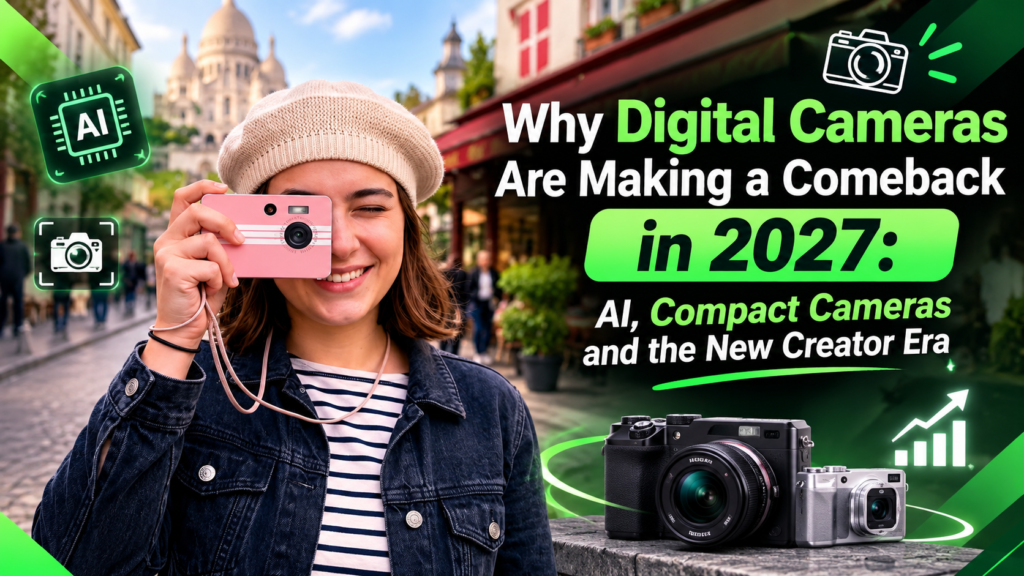
But something interesting is happening. Dedicated digital cameras are attracting renewed attention, particularly compact cameras and equipment designed for content creators.
Why would someone buy a digital camera when their smartphone can already take excellent pictures?
The answer isn’t simply image quality. People are looking for different photography experiences, greater creative control, better video capabilities, and technology that smartphones cannot always replace.
As we approach 2027, let’s explore what’s changing and why the digital camera industry deserves another look.
The Unexpected Return of Compact Digital Cameras
Remember those small digital cameras people used before smartphones became popular?
Interestingly, compact cameras are attracting attention again.
Canon’s 2026 Integrated Report highlights renewed interest in compact digital cameras, particularly among younger users who want something different from smartphone photography.
This isn’t necessarily about replacing smartphones. It’s about having another way to capture memories.
A dedicated camera can offer physical controls, optical zoom, different shooting experiences, and a design that appeals to photography enthusiasts.
Some people also enjoy the experience of taking pictures with a separate device rather than using the same phone they use for everything else.
Read more in Canon’s 2026 Integrated Report.
How AI Is Making the Digital Camera Smarter
One of the most interesting changes is the growing role of artificial intelligence in photography.
AI is no longer limited to editing photographs after they have been taken. It is increasingly involved in how cameras recognize subjects, track movement, and process images.
Imagine photographing a fast-moving bird. Instead of manually adjusting focus every time it moves, an intelligent autofocus system can recognize the animal and help keep it in focus.
Other applications include:
- Recognizing people, animals, and vehicles.
- Tracking moving subjects.
- Improving image processing.
- Helping reduce image noise.
- Supporting faster photo selection and editing.
Canon has discussed how AI and deep learning could influence future camera technology.
Read Canon’s AI camera technology discussion on PetaPixel.
The interesting question for 2027 is how far manufacturers will take this technology.
Why Content Creators Are Changing the Camera Market
Photography is no longer just about taking beautiful pictures.
Today, millions of people create videos for YouTube, Instagram, TikTok, online businesses, and educational platforms.
This has changed what buyers expect from a digital camera.
A creator might need one device for product photography, another type of recording for YouTube, and reliable autofocus for filming themselves.
As a result, manufacturers are paying greater attention to:
Video quality: Better recording capabilities for professional-looking content.
Autofocus: Keeping faces and moving subjects in focus.
Stabilization: Reducing unwanted camera movement.
Connectivity: Making it easier to transfer content to computers and smartphones.
Portability: Creating smaller equipment that is easier to carry.
The camera is becoming a content creation tool rather than simply a photography device.
Digital Camera vs Smartphone: Which One Makes More Sense in 2027?
The competition between smartphones and dedicated cameras is not as simple as choosing which produces the best photograph.
Each has its strengths.
| Feature | Digital camera | Smartphone |
|---|---|---|
| Portability | Depends on model | Excellent |
| Lens flexibility | Often interchangeable | Usually fixed camera modules |
| Manual controls | More extensive | Varies by device |
| Everyday convenience | Requires carrying another device | Always available |
| Professional photography | Greater equipment flexibility | Useful for many situations |
| Video creation | Advanced dedicated options | Excellent for quick content |
For travel and everyday photography, a smartphone might be all you need.
For wildlife, professional portraits, commercial photography, and more advanced video production, a dedicated camera can offer important advantages.
The best option depends on what you want to create.
Five Digital Camera Developments Worth Watching in 2027
Rather than predicting specific products, these are the technology areas worth following.
1. More intelligent autofocus
AI-powered subject recognition could become increasingly useful for photographers who capture fast-moving scenes.
2. Better computational photography
Combining sensor technology with advanced image processing could help cameras produce better results in challenging lighting conditions.
3. More creator-focused cameras
Video-first compact cameras and hybrid photography equipment could attract more independent creators.
4. Smarter camera and lens systems
Camera bodies, lenses, and editing software are becoming more connected, creating opportunities for improved workflows.
5. Better integration with editing tools
Faster wireless transfers and connected applications could make it easier to move photographs from the camera to editing and publishing platforms.
These are emerging directions, not guaranteed features of every camera released in 2027.
Is Buying a Digital Camera Worth It in 2027?
It depends on how you use photography.
If you mainly take casual photographs, share pictures with friends, and post on social media, your smartphone may be enough.
But if you want to learn photography, produce professional content, photograph distant subjects, or have more creative control, a dedicated digital camera could be a worthwhile investment.
Before buying, consider the total cost. The camera body is only one part of the expense. Lenses, batteries, memory cards, and other accessories can add considerably to the price.
It is also worth considering whether you really need the latest model. A previous-generation camera may offer everything you need at a lower price.
The Real Story Behind the Digital Camera Comeback
The return of interest in dedicated cameras tells us something interesting about digital technology.
Newer doesn’t always mean that older technology becomes useless.
Smartphones have made photography easier, but dedicated cameras continue to offer experiences and capabilities that many people still value.
In 2027, the most interesting development may not be a camera with more megapixels or a bigger screen. It could be the combination of intelligent software, creative freedom, and equipment designed around how people actually create photographs and videos.
Perhaps the future of photography isn’t about choosing between smartphones and cameras. It’s about having the right tool for the moment.