
In this story
Published: November 6, 2026 | Updated for 2027
Running a business requires more than selling products or providing services. Entrepreneurs must understand their customers, manage expenses, attract new buyers, communicate professionally, and make decisions that support long-term growth.
Artificial intelligence can help with many of these responsibilities. In particular, ChatGPT prompts for business can help entrepreneurs organize ideas, prepare marketing campaigns, improve customer communication, and develop practical business plans.
However, simply asking ChatGPT to grow your business is unlikely to produce a useful strategy. The quality of the response depends on the information you provide, the instructions you give, and how carefully you review the results.
For example, asking for marketing ideas without explaining your audience or budget may produce suggestions that are too general to implement. Providing your business type, customer profile, available resources, and objectives gives ChatGPT a much clearer starting point.
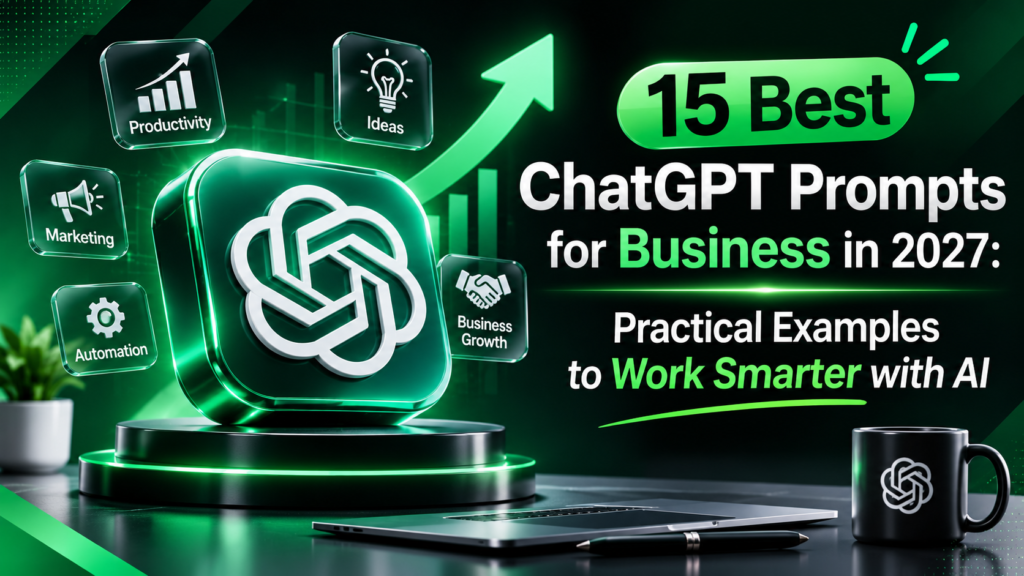
In this guide, we explore 15 practical ChatGPT prompts for business, demonstrate how to customize them, and explain how entrepreneurs can use AI without relying on inaccurate information or unrealistic recommendations.
Whether you operate an online store, manage a startup, work as a freelancer, or run a small company, these examples can help you make better use of AI in everyday business activities.
1. What Can ChatGPT Actually Do for a Business?
ChatGPT is an AI assistant that can help businesses work with information, generate ideas, organize tasks, and prepare written content.
Rather than treating it as an automatic business solution, think of it as an assistant that helps you complete specific tasks.
Here are some practical examples:
| Business activity | How ChatGPT can help |
|---|---|
| Planning | Organize business ideas and create action plans |
| Marketing | Develop campaigns and promotional content |
| Sales | Prepare sales messages and customer follow-ups |
| Customer service | Draft responses to common questions |
| Finance | Organize budgets and explain calculations |
| Productivity | Prepare schedules and meeting summaries |
| Research | Develop competitor research questions |
| Operations | Identify repetitive tasks and workflow improvements |
One important distinction: ChatGPT can help you prepare a competitor analysis, but it cannot automatically guarantee that every competitor or market statistic it mentions is accurate.
For research-based tasks, use reliable sources to verify important information.
For additional examples, explore OpenAI’s Small Business Prompt Pack.
2. How to Write a Business Prompt That Produces Useful Results
Before using the prompts below, understand a simple principle: ChatGPT needs context.
A useful prompt should explain what you are trying to achieve, who your customers are, and what kind of result you expect.
A practical structure contains five elements:
- Role: Tell ChatGPT what professional perspective to use.
- Context: Explain your business, industry, and situation.
- Objective: Describe the problem you want to solve.
- Output: Specify the format you need.
- Limitations: Explain your budget, restrictions, and information that must not be invented.
Example: A weak prompt versus a detailed prompt
Weak prompt:
“Give me ideas to increase my online store sales.”
Improved prompt:
“Act as an e-commerce marketing consultant. I operate an online clothing store targeting customers aged 18–35 in the United States. My monthly marketing budget is $300. Identify 10 affordable ways to attract potential customers and improve product visibility. Organize the ideas by estimated cost, difficulty, and implementation steps. Do not guarantee sales or invent statistics.”
The second prompt gives ChatGPT enough information to produce suggestions that are more relevant to the situation.
You can also improve the answer through follow-up instructions, such as:
- Which three ideas are easiest to implement?
- How can I do this with a $100 budget?
- What tools would I need?
- How can I measure whether the strategy is working?
For further reading, see OpenAI’s Prompt Engineering Best Practices.
3. The 15 Best ChatGPT Prompts for Business
The following prompts cover five important business areas. Each includes a practical purpose and instructions you can customize instead of copying without considering your situation.
Category 1: Business Planning and Research
A business idea needs more than enthusiasm. Entrepreneurs must understand the problem they want to solve, identify potential customers, and investigate whether there is sufficient demand.
Prompt 1: Build a Practical Business Plan
Best for: New entrepreneurs and startups.
Act as a business planning consultant. I want to start a [business type] in [location]. My available startup budget is [amount], and my target customers are [audience].
Develop a practical business plan covering the business concept, customer problem, proposed solution, revenue model, competitors to research, startup requirements, potential risks, marketing approach, and a 90-day launch plan.
Separate assumptions from verified information. Identify which parts require market research before I invest money.
Why this is useful: It helps turn an early business idea into a structured plan. More importantly, it highlights questions that need answers before launching.
Prompt 2: Find Business Opportunities Within My Budget
Best for: People exploring new business ideas.
Act as a business opportunity researcher. My skills are [skills], my interests are [interests], and my available startup budget is [amount]. Suggest 10 realistic business ideas suitable for my situation.
For each idea, explain the customer problem, target audience, possible revenue model, resources required, competition, and main risks.
Rank the ideas by startup difficulty and explain how I could test customer demand before investing.
Practical tip: Do not select an idea simply because ChatGPT describes it as profitable. Investigate customer demand, competitors, operating costs, and local requirements first.
Prompt 3: Understand My Target Customers
Best for: Online stores, freelancers, and service businesses.
Act as a market research assistant. My business offers [product or service] to customers in [market].
Identify three potential customer segments. For each segment, describe their needs, purchasing motivations, common objections, problems, and preferred communication channels.
Create a customer persona for each segment and suggest five questions I can ask real customers to validate your suggestions.
Why this is useful: It gives you a starting framework for customer research instead of relying entirely on assumptions about your audience.
Category 2: Marketing and Content Creation
Marketing is one of the areas where AI can save considerable preparation time. However, successful marketing still requires accurate product information and an understanding of your audience.
Prompt 4: Develop a Marketing Strategy
Best for: Small businesses and startups.
Act as a digital marketing strategist. My business is [business type], and I sell [product or service] to [target audience].
My main objective is [website traffic, brand awareness, leads, or sales], and my monthly budget is [amount].
Create a 30-day marketing strategy covering audience research, positioning, marketing channels, content ideas, advertising options, estimated costs to investigate, and measurable performance indicators.
Prioritize affordable activities and explain how I can evaluate their effectiveness.
Prompt 5: Create a 30-Day Social Media Calendar
Best for: Business owners managing their own social media.
Act as a social media content strategist. My business operates in [industry], and my audience is [audience].
Create a 30-day content calendar for [Instagram, Facebook, TikTok, or LinkedIn].
Include the topic, content format, suggested caption, visual concept, and call to action for each post.
Avoid repeating ideas. Balance educational content, product information, customer questions, and promotional posts.
Prompt 6: Write Better Product Descriptions
Best for: E-commerce businesses.
Act as an e-commerce copywriter. Rewrite the following product description for [product name].
Target audience: [audience].
Verified product features: [features].
Write a clear headline, an engaging introduction, key features, customer benefits, practical specifications, and a call to action.
Do not invent certifications, product specifications, guarantees, or benefits that I have not provided.
Original description: [paste description].
Prompt 7: Prepare a Marketing Email Campaign
Best for: Businesses communicating with existing customers.
Act as an email marketing specialist. My company offers [product or service], and the campaign objective is [objective].
Prepare a five-email sequence containing an introduction, useful information, product benefits, answers to common objections, and a final invitation to take action.
Include subject lines, preview text, email content, and calls to action.
Keep the messages natural and informative. Avoid false urgency and unsupported promotional claims.
Category 3: Sales and Customer Communication
Getting potential customers interested is only one part of running a business. You must also communicate clearly, answer questions, and help customers understand what you offer.
Prompt 8: Write a Professional Sales Pitch
Best for: Freelancers and business development teams.
Act as a professional sales communication consultant. I offer [product or service] to [target customer].
The main problem I solve is [customer problem], and my verified product benefits are [benefits].
Write three sales pitches: a short introduction, a professional email pitch, and a detailed presentation.
Make the language persuasive but natural. Do not exaggerate results or promise outcomes that cannot be guaranteed.
Prompt 9: Respond to an Unhappy Customer
Best for: Customer service teams and small businesses.
Act as an experienced customer support representative. A customer has complained about [problem].
Our actual company policy is [policy].
Write a professional response that acknowledges the customer’s concern, demonstrates empathy, explains the available solution, and provides clear next steps.
Do not promise compensation, refunds, or deadlines that are not authorized by our policy.
Prompt 10: Improve Customer Follow-Ups
Best for: Freelancers and businesses with potential customers.
Write a friendly follow-up message to a potential customer who previously expressed interest in [product or service] but has not responded.
Remind them briefly of the main benefit, offer to answer questions, and suggest a reasonable next step.
Create three versions: friendly, formal, and concise. Avoid pressure or misleading urgency.
Category 4: Finance and Business Productivity
Business owners must understand their expenses, organize their time, and keep track of important responsibilities.
ChatGPT can help structure this information, although important financial and tax decisions should be reviewed by qualified professionals.
Prompt 11: Organize a Monthly Business Budget
Best for: Small businesses and freelancers.
Act as a business budgeting assistant. My estimated monthly revenue is [amount].
My known expenses are [list expenses].
Organize the information into revenue, fixed costs, variable costs, subscriptions, marketing, and other expenses.
Calculate the totals using the numbers provided. Identify missing information and explain the difference between revenue, expenses, gross profit, and net profit.
Prompt 12: Create a Realistic Weekly Work Schedule
Best for: Entrepreneurs managing multiple responsibilities.
Act as a productivity consultant. I run a [business type] and need to manage [responsibilities].
My working hours are [hours], and my three main priorities are [priorities].
Prepare a realistic weekly schedule that organizes important tasks, customer communication, administration, marketing, and planning.
Include breaks and time for unexpected responsibilities. Explain which activities should receive the highest priority.
Prompt 13: Turn Meeting Notes into an Action Plan
Best for: Business owners and teams.
Organize the following meeting notes into a professional report.
Identify the main discussion points, decisions, assigned tasks, responsible people, deadlines, unresolved questions, and follow-up requirements.
Do not invent decisions, names, or deadlines.
Meeting notes: [paste notes].
Category 5: Business Growth and AI Automation
Once everyday business activities are organized, you can investigate opportunities to improve operations and reduce repetitive work.
Prompt 14: Identify Opportunities to Automate Business Tasks
Best for: Businesses looking to improve their workflows.
Act as an AI workflow consultant. My business operates in [industry], and I want to improve [specific business process].
Analyze the process and identify repetitive tasks that may benefit from automation.
For each opportunity, explain the task, suggested digital tools, implementation difficulty, possible benefits, privacy risks, and activities that should remain under human supervision.
Recommend a simple starting workflow that does not require a large budget.
Prompt 15: Create a 90-Day Business Growth Plan
Best for: Established small businesses and entrepreneurs.
Act as a business growth consultant. My company offers [product or service] to [target audience].
Our current situation is [describe business performance], and our biggest challenge is [challenge].
Create a practical 90-day improvement plan covering marketing, customer acquisition, sales, operations, and productivity.
Divide the plan into weekly priorities. Include measurable indicators, required resources, potential risks, and ways to evaluate progress.
Clearly distinguish recommendations from assumptions. Do not guarantee financial results.
4. Practical Example: Using ChatGPT to Improve a Small Online Store
Let’s put the prompts into a realistic business situation.
Imagine you operate an online clothing store in the United States. You have a limited marketing budget of $300 per month, and your website receives relatively little traffic.
Instead of asking ChatGPT to solve every problem at once, start with a specific objective.
Step 1: Identify the problem
Your first task is to understand why potential customers are not discovering your products.
Use Prompt 3 to identify possible customer groups and develop questions for customer research.
For example, you might investigate:
- Which products customers are searching for.
- What influences their purchasing decisions.
- Whether shipping costs affect their choices.
- Which social media platforms they use.
- What information they expect before purchasing.
These are research questions, not confirmed findings. You need real customer feedback to establish the answers.
Step 2: Improve product pages
Choose one product and use Prompt 6 to improve its description.
Provide the actual material, size, available colors, price, and other specifications.
Then compare the original and revised descriptions.
<text style=”strong”>What should you evaluate?</text>
- Is the product easier to understand?
- Are the important details visible?
- Does the description answer customer questions?
- Are all product claims accurate?
- Is the call to action clear?
Step 3: Create a marketing plan
Use Prompt 4 to develop a marketing strategy around your available budget.
Ask ChatGPT to divide the budget into possible activities, but research actual advertising costs before spending money.
Then use Prompt 5 to prepare social media content.
Step 4: Measure the results
After implementing your changes, review real business data.
For example, track:
| Metric | What it tells you |
|---|---|
| Website visitors | Whether traffic is increasing |
| Product page views | Which products attract attention |
| Add-to-cart rate | Whether visitors show purchase interest |
| Conversion rate | How many visitors complete purchases |
| Advertising cost | How much you spend to attract customers |
This is where business judgment becomes essential. ChatGPT can help organize the results, but your decisions should be based on actual performance data.
5. Common Mistakes to Avoid When Using ChatGPT for Business
Even detailed prompts can produce inaccurate, unsuitable, or impractical suggestions. Knowing the limitations of AI is therefore just as important as knowing how to write good prompts.
Here are five mistakes worth avoiding.
1. Providing too little information
Asking for a business strategy without explaining your industry, audience, budget, or objectives often leads to generic recommendations.
Improvement: Give ChatGPT relevant details before requesting a solution.
2. Trusting every statistic
AI-generated answers can contain incorrect figures, outdated information, or unsupported market claims.
Improvement: Verify important statistics using reliable sources, official reports, and current market research.
3. Publishing AI-generated content without editing
A generated article, advertisement, or email may contain repetitive expressions, inaccurate claims, or wording that does not match your brand.
Improvement: Review the content, add genuine business knowledge, and make it relevant to your customers.
4. Sharing confidential business information
Avoid entering passwords, payment details, private customer records, or sensitive employee information into AI tools without appropriate safeguards.
Improvement: Remove unnecessary personal and confidential information before using AI.
5. Expecting guaranteed business results
ChatGPT cannot guarantee sales, website traffic, customer acquisition, or business profitability.
Improvement: Treat its recommendations as ideas to investigate and test rather than guaranteed outcomes.
For further information, consult the OpenAI Privacy Policy and the NIST AI Risk Management Framework.
6. Useful AI and Digital Tools to Combine with ChatGPT
ChatGPT does not need to be your only business tool. Depending on your needs, other digital platforms can help you manage design, research, communication, and everyday operations.
Here are several examples:
| Tool | Practical business use |
|---|---|
| Canva | Marketing graphics and presentations |
| Google Gemini | AI assistance and productivity |
| Claude | Writing and document analysis |
| Perplexity | Research and source discovery |
| Notion | Documentation and organization |
| Trello | Task and project management |
| Zapier | Connecting applications and automating workflows |
| HubSpot | Customer relationship management |
| Google Analytics | Website traffic analysis |
| Google Search Console | Search performance monitoring |
The best combination depends on your business size, budget, and workflow. Before purchasing subscriptions, compare current pricing, features, usage limits, and privacy policies.
7. Frequently Asked Questions About ChatGPT Prompts for Business
What are the most useful ChatGPT prompts for business?
Business planning, marketing strategy, customer research, sales communication, budgeting, and workflow automation are useful starting points. The best prompt depends on the specific problem you want to solve.
Can ChatGPT help me start a small business?
Yes. It can help you explore business ideas, prepare a business plan, identify potential customers, organize startup tasks, and develop marketing strategies. However, you should independently validate market demand, costs, and legal requirements.
Are ChatGPT prompts for business free?
Many prompts can be used with ChatGPT’s free access. However, available models, features, and usage limits depend on the current plan and product availability.
Can ChatGPT help increase business sales?
It can help improve product descriptions, prepare sales messages, develop marketing ideas, and organize customer communication. However, increased sales are not guaranteed and depend on many factors beyond the quality of a prompt.
Can ChatGPT replace a business consultant?
No. ChatGPT can support research, planning, and brainstorming, but it cannot replace professional experience, industry knowledge, or qualified legal and financial advice.
How can I get more accurate business answers?
Provide specific context, use reliable information, explain your objectives, and request clearly structured results. Verify important claims and use follow-up questions to improve the answer.
Conclusion: Use AI as a Business Assistant, Not a Replacement for Good Decisions
Artificial intelligence is becoming an increasingly useful part of modern business workflows. From writing marketing emails to organizing budgets and developing customer communication strategies, ChatGPT can help entrepreneurs approach everyday responsibilities more efficiently.
The 15 ChatGPT prompts in this guide provide practical starting points for small business owners, freelancers, marketers, and entrepreneurs.
However, the real value does not come from copying as many prompts as possible. It comes from choosing the right instructions, providing accurate information, reviewing the results, and applying useful suggestions to real business situations.
Our recommendation: Start with one business challenge, choose the most relevant prompt, and test its suggestions on a small scale. Measure the results before expanding your approach.
Ultimately, successful businesses need more than AI-generated answers. They need reliable information, customer understanding, creativity, and responsible decision-making.
At Zawana Blog, we explore artificial intelligence, digital technology, and practical tools that help readers understand and navigate the evolving digital world.