

In this story
10 Powerful Solutions for Claims, Fraud Detection and Underwriting
Artificial intelligence is changing the insurance industry. Insurance companies are increasingly using AI to process claims, detect suspicious activities, evaluate risks, analyze documents, and improve customer service.
Instead of spending hours reviewing paperwork and manually checking information, insurance professionals can use AI-powered software to automate repetitive tasks and make better-informed decisions.
But which AI tools are actually worth considering?
In this guide, we explore 10 AI tools for insurance companies in 2026, including specialized insurance platforms and more accessible AI solutions. We also compare free options, limited free trials, and paid enterprise software to help businesses understand their choices.
How Can AI Help Insurance Companies?
AI can support several important insurance operations:
- Claims processing: Analyze claim documents, organize information, and accelerate routine workflows.
- Fraud detection: Identify unusual patterns and potentially suspicious claims.
- Risk assessment: Help underwriters evaluate applications and understand potential risks.
- Document processing: Extract information from forms, invoices, reports, and insurance documents.
- Customer service: Assist employees with policy questions and customer communications.
- Workflow automation: Reduce repetitive administrative work and improve operational efficiency.
AI does not eliminate the need for experienced insurance professionals. Important decisions involving coverage, risk, fraud, and claim approval should remain subject to appropriate human review.
10 Best AI Tools for Insurance Companies in 2026
1. Guidewire Insurance AI – Best for Insurance Operations
Guidewire is an established insurance technology platform that provides AI capabilities for property and casualty (P&C) insurers.
Its AI solutions support underwriting, claims management, customer service, and insurance workflows. Its ProNavigator assistant can help employees find policy information, understand claims, and complete routine tasks inside Guidewire applications.
Main features:
- AI assistance for claims adjusters.
- Underwriting support and risk insights.
- Customer service assistance.
- AI agents for insurance workflows.
- Integration with insurance systems.
Pricing: Enterprise / custom pricing. Contact Guidewire for a demonstration and commercial offer.
Free availability: No general free plan or publicly listed self-service free trial. A product demonstration can be requested.

Official website:
2. FRISS – Best for Insurance Fraud Detection
FRISS specializes in AI-powered fraud detection and risk assessment for insurance companies.
It analyzes information from insurance applications and claims to help insurers identify suspicious activities and prioritize investigations. It also supports underwriting analytics and compliance screening.
Main features:
- Insurance fraud detection.
- Claims risk scoring.
- Underwriting analytics.
- Investigation support.
- Detection of manipulated or AI-generated claim documents and images.
Pricing: Custom enterprise pricing.
Free availability: No publicly advertised free plan. Contact FRISS to request a demonstration.
Official website:
3. Shift Technology – Best for Claims Automation and Fraud Detection
Shift Technology provides AI-powered decision solutions designed specifically for insurance companies.
Its platform helps insurers analyze claims, identify potential fraud, understand claim information, and recommend appropriate next steps.
Main features:
- AI-powered claims analysis.
- Fraud detection and investigation support.
- Claims workflow automation.
- Identification of suspicious patterns.
- Insurance decision support.
Pricing: Custom pricing depending on business requirements and implementation.
Free availability: No publicly listed free plan. A business demonstration is available through the company.
Official website:
4. Tractable – Best for AI-Powered Vehicle Damage Assessment
Tractable uses computer vision and artificial intelligence to analyze images of damaged vehicles and support insurance claims.
This technology can help motor insurers and repair networks assess vehicle damage more efficiently.
Main features:
- Vehicle damage image analysis.
- AI-assisted repair assessment.
- Claims processing support.
- Visual damage recognition.
- Integration with insurance workflows.
Pricing: Custom enterprise pricing.
Free availability: No public free plan or standard self-service trial advertised. Contact the company for a demonstration.

Official website:
5. Akur8 – Best for Insurance Pricing and Risk Modeling
Akur8 is an AI-powered insurance pricing platform designed to help actuaries and pricing teams build and update insurance risk models.
It combines machine learning with transparent modeling techniques, helping insurers improve pricing processes while maintaining the ability to understand their models.
Main features:
- Insurance pricing models.
- Risk analysis.
- Predictive modeling.
- Actuarial workflow support.
- Explainable machine learning.
Pricing: Custom pricing based on company requirements.
Free availability: No general free plan publicly advertised. Contact Akur8 for a product demonstration.
Official website:
6. Nanonets – Best for Insurance Document Processing
Nanonets provides AI-powered document processing and workflow automation.
Insurance companies can use it to extract information from forms, invoices, applications, and other business documents, reducing manual data entry.
Main features:
- Document data extraction.
- Automated document classification.
- Invoice and form processing.
- Workflow automation.
- Integration with business applications.
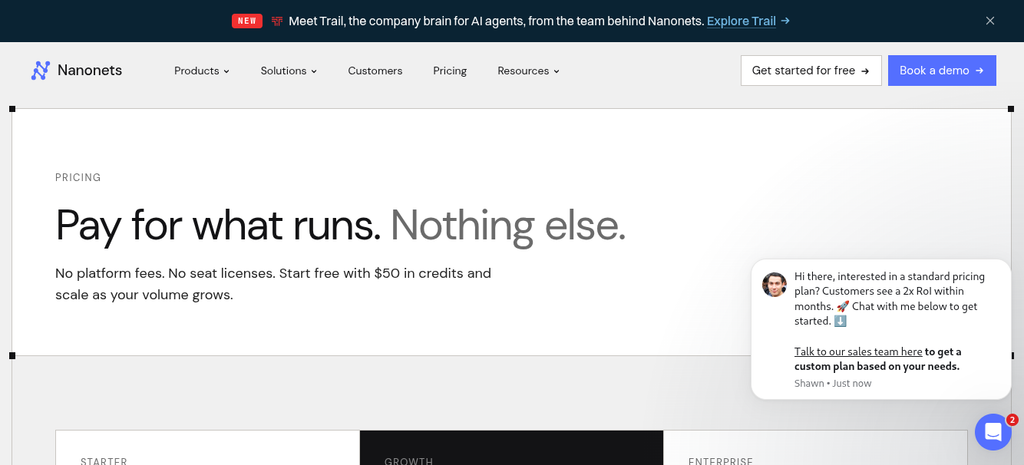
Pricing: Offers paid plans, with pricing depending on usage and selected features.
Free availability: Free trial availability is advertised. Check its current pricing page for the latest eligibility and limits.
Official website:
7. UiPath Document Understanding – Best for Document Automation
UiPath provides intelligent document processing and robotic process automation (RPA).
Insurance companies can use it to extract information from structured and unstructured documents and connect document processing with automated business workflows.
Main features:
- AI document understanding.
- Data extraction from forms.
- Automated document classification.
- Integration with RPA workflows.
- Reduced manual processing.
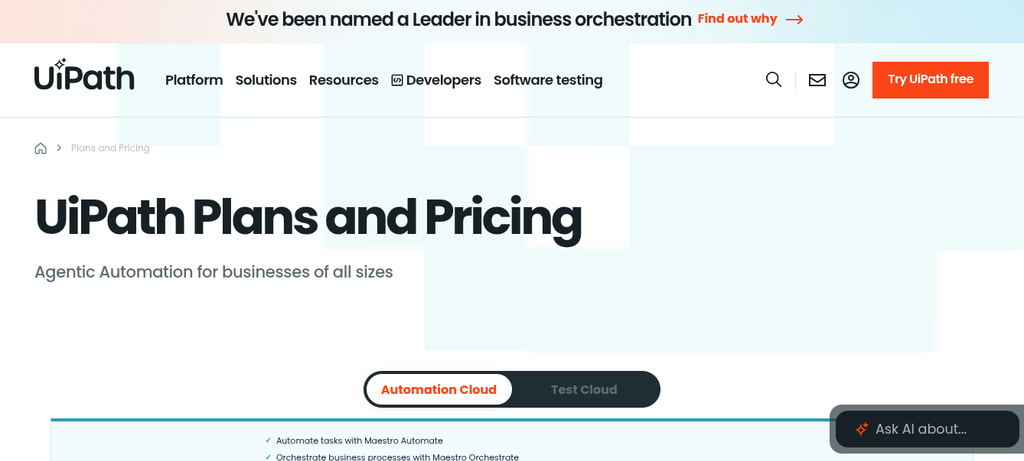
Pricing: Paid plans and enterprise options. Pricing depends on the selected products and usage.
Free availability: UiPath offers a free entry option for eligible users and products. Check the official pricing page to confirm which Document Understanding features are included and whether usage is limited.
Official website:
8. Microsoft Copilot – Best for Everyday Insurance Office Work
Microsoft Copilot can help insurance professionals with everyday productivity tasks, especially when used with supported Microsoft 365 applications.
It can assist with drafting emails, summarizing documents, preparing reports, organizing information, and analyzing business data.
Main features:
- Email and document assistance.
- Report summaries.
- Spreadsheet support.
- Meeting summaries.
- Business productivity assistance.
Pricing: Free Copilot experiences are available, while Microsoft 365 Copilot for organizations requires a paid subscription and may have additional eligibility requirements.
Free availability: Yes, limited free access is available. Business features and organizational integrations require checking the relevant subscription.
Official website:
9. ChatGPT – Best for Research, Writing and Business Assistance
ChatGPT can support insurance professionals with research, writing, communication, and general business tasks.
For example, an insurance agent can use it to draft customer emails, explain complex policy language in simpler terms, prepare internal reports, or create frequently asked questions.
Main features:
- Drafting customer communications.
- Summarizing documents.
- Preparing reports.
- Creating training materials.
- Brainstorming customer service responses.
Pricing: Free access is available, with paid individual and business subscriptions offering additional capabilities.
Free availability: Yes, with usage limits. Paid plans provide additional features and capacity.
Official website:
Important: Do not upload confidential customer records, personal information, or sensitive insurance documents to a general AI service unless your organization has approved the service and its data protection settings.
10. Google Gemini – Best for General AI Assistance and Productivity
Google Gemini is a general-purpose AI assistant that can help insurance employees with research, writing, summarization, and productivity.
It may be useful for small insurance agencies and professionals who need an accessible AI assistant for everyday tasks rather than a specialized insurance platform.
Main features:
- Writing and editing.
- Research assistance.
- Document summarization.
- Brainstorming.
- Productivity support.
Pricing: Free access is available, with paid Google AI plans offering additional features and usage limits.
Free availability: Yes, subject to availability and usage limits.
Official website:
Free AI Tools vs. Free Trials vs. Paid Insurance Software
Not every AI tool offers the same pricing model. It is important to understand the difference before choosing software.
| Tool | Free option | Free trial | Paid option |
|---|---|---|---|
| Guidewire | No public free plan | Demo available | Custom |
| FRISS | No public free plan | Demo available | Custom |
| Shift Technology | No public free plan | Demo available | Custom |
| Tractable | No public free plan | Demo available | Custom |
| Akur8 | No public free plan | Demo available | Custom |
| Nanonets | Check current offer | Advertised | Yes |
| UiPath | Free entry option | Depends on product | Yes |
| Microsoft Copilot | Yes, limited | Depends on subscription | Yes |
| ChatGPT | Yes, limited | No standard universal trial | Yes |
| Google Gemini | Yes, limited | Depends on plan | Yes |
Important pricing note: A demonstration is not the same as a free trial. Enterprise insurance platforms often negotiate prices according to company size, policy volume, integrations, and implementation requirements. Always confirm the latest pricing and trial conditions with the provider.
Which AI Tool Should an Insurance Company Choose?
The right choice depends on the company’s main challenge.
- For fraud detection: FRISS and Shift Technology are strong specialized options.
- For claims management: Guidewire and Shift Technology offer insurance-focused solutions.
- For vehicle damage assessment: Tractable is worth considering.
- For insurance pricing: Akur8 is designed for actuarial and pricing teams.
- For document processing: Nanonets and UiPath are useful options.
- For everyday office productivity: Microsoft Copilot, ChatGPT, and Google Gemini offer more accessible starting points.
Small insurance agencies do not necessarily need expensive enterprise software. They can begin by evaluating general AI assistants for administrative work, provided they follow their organization’s privacy and compliance requirements.
Larger insurance companies may benefit more from specialized platforms that integrate with their existing policy, claims, and underwriting systems.
What Should You Check Before Buying AI Insurance Software?
Before investing in an AI platform, consider these important questions:
- Data security: How does the provider protect customer information?
- Integration: Can the software connect with your existing insurance systems?
- Accuracy: How does the provider measure the quality of its AI results?
- Human oversight: Can employees review and correct AI-generated decisions?
- Transparency: Can the company explain why the AI flagged a claim or recommended an action?
- Pricing: Are implementation, integration, and usage fees included?
- Compliance: Does the solution support the privacy and regulatory requirements applicable to your market?
An AI platform should improve the work of insurance professionals, not introduce unnecessary risks or replace important human judgment.
Final Thoughts
AI is becoming an important part of the insurance industry’s digital transformation. From fraud detection and risk assessment to claims processing and document automation, specialized AI platforms can help insurers improve efficiency and manage complex workflows.
However, the most expensive solution is not always the best one.
For companies looking for specialized insurance technology, Guidewire, FRISS, Shift Technology, Tractable, and Akur8 offer solutions designed around insurance operations. For businesses that need more accessible productivity and document tools, ChatGPT, Microsoft Copilot, Google Gemini, Nanonets, and UiPath are worth evaluating.
The best approach is to identify your company’s biggest operational challenge, test suitable solutions where possible, and evaluate their security, accuracy, integration, and total cost before making a decision.
Frequently Asked Questions
What is the best AI tool for insurance companies?
There is no single best tool for every insurance company. FRISS and Shift Technology focus on fraud detection, Guidewire supports insurance operations, Tractable specializes in vehicle damage assessment, and Akur8 focuses on insurance pricing.
Are there free AI tools for insurance companies?
Yes. ChatGPT, Google Gemini, and Microsoft Copilot offer limited free access for general productivity tasks. Some document automation providers also advertise trial options. However, specialized insurance platforms generally use custom business pricing.
Can AI detect insurance fraud?
AI can identify suspicious patterns, unusual claim activity, and potentially manipulated documents or images. However, an AI alert is not proof of fraud. Investigators and qualified professionals must review relevant evidence.
Can small insurance agencies use AI?
Yes. Small agencies can start with general AI assistants for drafting emails, summarizing information, preparing reports, and organizing workflows. They should avoid sharing confidential customer information without appropriate authorization and data protection.
Does AI replace insurance agents and claims adjusters?
AI can automate repetitive tasks and support analysis, but human professionals remain important for customer relationships, complex claims, investigations, regulatory decisions, and final judgment.
Are AI insurance tools expensive?
It depends on the product. General AI assistants may offer free access and affordable subscriptions, while specialized insurance platforms often use custom enterprise pricing based on business needs, integrations, and usage.