

In this story
Published: November 6, 2026
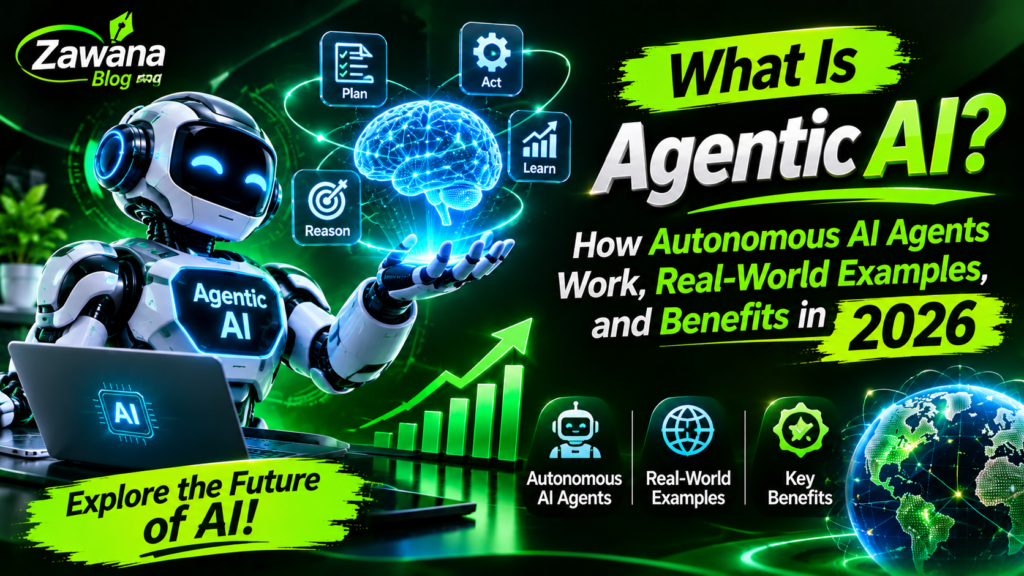
Artificial intelligence is moving beyond answering questions, generating images, and writing content. A new generation of AI technology is changing how people interact with computers, complete everyday tasks, and manage business operations. One of the most interesting developments is Agentic AI.
Unlike traditional AI tools that mainly respond to instructions, agentic AI systems can understand goals, plan actions, use digital tools, and complete multiple steps with limited human guidance. This means that instead of simply asking an AI assistant how to organize a project, you may be able to give it the goal and let it work through the necessary tasks.
But what exactly is agentic AI? How does it work? Can it really perform tasks independently? And what opportunities could it create for businesses, developers, and everyday users?
In this guide, we will explore everything beginners need to know about agentic AI, including its technology, practical applications, advantages, limitations, and potential future developments.
1. What Is Agentic AI?
Agentic AI is a type of artificial intelligence that can pursue specific goals by planning, making decisions, using tools, and taking actions with a degree of autonomy.
Traditional AI usually waits for a user to provide an instruction before generating a response. Agentic AI goes further by interpreting a broader objective, breaking it into smaller tasks, deciding what steps are necessary, and adjusting its approach when circumstances change.
For example, imagine asking an ordinary AI chatbot to help you plan a business meeting. It might suggest an agenda, recommend discussion topics, and create a list of preparations.
An agentic AI system could potentially do much more. With the appropriate permissions and connected tools, it could:
- Research the meeting topic.
- Prepare an agenda.
- Check available calendar times.
- Draft invitations.
- Organize relevant documents.
- Send invitations after receiving the required approval.
- Follow up with participants.
The important difference is that the system is not simply generating information. It is working toward a defined result.
Agentic AI can operate through one AI agent or multiple specialized agents working together. However, its independence depends on the system’s design, available tools, permissions, and safety controls.
2. How Does Agentic AI Work?
Agentic AI combines several technologies to understand instructions and complete tasks. Large language models (LLMs) often provide the reasoning and language capabilities, while external tools allow agents to interact with other systems.
Although implementations vary, most agentic workflows involve several important stages.
Step 1: Understanding the Goal
First, the AI receives an objective from the user or another system.
For example, a business owner might request:
“Research five competitors, compare their products, and prepare a market analysis.”
The agent interprets the request and identifies the expected result.
Step 2: Planning the Tasks
Next, the agent divides the objective into smaller steps.
For the market research example, it might decide to:
- Identify five relevant competitors.
- Visit their websites.
- Collect information about their products.
- Compare prices and features.
- Organize the findings.
- Prepare a final report.
This planning stage helps the AI approach a complicated objective systematically.
Step 3: Using Tools and Collecting Information
An AI agent can connect to external tools, databases, APIs, browsers, and business applications.
These integrations allow it to retrieve information and perform permitted operations instead of relying only on the information contained in its original training.
For example, an agent might use a search tool to research competitors, a spreadsheet application to organize prices, and a document editor to prepare a report.
Step 4: Taking Action
After gathering the necessary information, the agent performs the next actions according to its instructions and permissions.
Depending on its configuration, it might create documents, update records, organize information, or communicate with connected applications.
Some actions may require human approval before execution.
Step 5: Checking Results and Adjusting
Agentic AI can evaluate the results of its actions and determine whether additional steps are necessary.
For example, if a competitor’s website does not provide pricing information, the agent might search another source or mark the information as unavailable.
This process can continue until the objective is completed, the agent reaches a limit, or human intervention becomes necessary.
In simple terms: Agentic AI follows a cycle of understanding, planning, acting, checking, and improving its approach.
3. What Are the Main Components of Agentic AI?
Several important technologies and capabilities help agentic AI systems operate.
Large Language Models (LLMs)
Large language models help agents understand natural language, interpret instructions, analyze information, and generate plans.
They provide much of the reasoning and communication capability behind modern AI agents.
Memory and Context
Memory allows an agent to retain relevant information during a task or across supported sessions.
For example, a customer support agent might use previous conversation details to understand a customer’s ongoing issue.
However, memory capabilities depend on the system and its configuration.
Tools and Integrations
Tools allow AI agents to interact with external services.
Examples include:
- Web browsers and search engines.
- Email and calendar applications.
- Databases and spreadsheets.
- APIs and business software.
- Code execution environments.
Without suitable tools and permissions, an agent may be able to explain how to perform an action but may not be able to perform it.
Planning and Reasoning
Planning helps an agent determine which steps are necessary to achieve an objective.
Reasoning capabilities also help it evaluate information, choose between possible actions, and respond to unexpected situations.
Guardrails and Human Oversight
Guardrails establish boundaries around what an AI agent can and cannot do.
For example, an agent might be allowed to draft an email but require human approval before sending it.
These controls are particularly important when agents interact with financial information, customer records, business systems, or sensitive data.
4. Agentic AI vs. Generative AI: What Is the Difference?
Agentic AI and generative AI are closely related, but they are not the same thing.
Generative AI focuses on producing new content, such as articles, images, videos, music, and computer code.
Agentic AI focuses on pursuing goals and completing tasks through planning and action. It can use generative AI models as part of its operation.
Consider this simple comparison:
| Feature | Generative AI | Agentic AI |
|---|---|---|
| Main purpose | Create content | Complete objectives |
| Typical behavior | Responds to prompts | Plans and takes actions |
| Task execution | Usually produces an output | Can perform multiple steps |
| Tool usage | May use connected tools | Uses tools as part of workflows |
| Decision-making | Primarily generates responses | Selects actions toward a goal |
| Example | Writes a blog post | Researches, drafts, and organizes a content project |
Example: If you ask generative AI to write a product description, it can create the text.
However, an agentic system could potentially research the product, compare competitors, draft the description, organize product information, and submit it for approval.
Both technologies can work together. Generative AI provides content and reasoning capabilities, while agentic workflows add planning, coordination, and action.
5. Real-World Examples of Agentic AI
Agentic AI has potential applications across many industries. Here are some practical examples of how organizations could use it.
1. Customer Service and Support
AI agents can help manage customer support requests by collecting information, checking order details, identifying common problems, and recommending solutions.
For example, an online store could use an agent to investigate a delayed delivery and prepare an appropriate response.
More complex cases can be transferred to human support representatives.
2. Business Automation
Businesses can use agentic AI to coordinate repetitive administrative workflows.
An agent could organize incoming requests, classify documents, update approved records, and prepare reports.
This can reduce manual work and help employees focus on more important responsibilities.
3. Marketing and Content Creation
Marketing teams can use AI agents to support research, campaign planning, audience analysis, and content organization.
For example, an agentic workflow might:
- Research trending topics.
- Identify relevant keywords.
- Analyze competing articles.
- Prepare content outlines.
- Draft social media posts.
- Organize campaign materials.
Human review remains important for accuracy, originality, brand consistency, and publishing decisions.
4. Software Development
AI agents can assist developers with programming tasks.
Depending on their tools and permissions, they can examine code, identify possible errors, suggest changes, run tests, and help debug applications.
Some development agents can also work through multiple steps of a coding task.
5. Finance and Accounting
Agentic AI could help businesses organize financial documents, categorize transactions, identify unusual patterns, and prepare financial summaries.
However, financial decisions and sensitive transactions require appropriate security measures and human supervision.
6. Healthcare Administration
Healthcare organizations may use AI agents to support administrative activities, such as organizing appointments, processing paperwork, and helping staff locate relevant information.
These systems must follow strict privacy, security, and regulatory requirements. They should not replace qualified medical professionals.
7. Online Shopping and E-Commerce
AI agents could help customers compare products, check availability, identify suitable options, and organize purchasing information.
For online retailers, they may also support inventory monitoring, customer communication, and order management.
6. What Are the Best Agentic AI Tools and Platforms in 2026?
The agentic AI ecosystem includes tools for everyday users, businesses, and developers. Some products provide ready-to-use AI assistants, while others offer platforms for building custom agents.
Here are several platforms worth exploring.
1. OpenAI Agents
OpenAI provides resources and development tools for creating AI agents that can use tools, follow instructions, and complete multi-step workflows.
Developers can explore the Agents SDK and other agent-building capabilities to create applications for business processes, research, and automation.
2. Google Cloud Agent Development
Google Cloud provides information and infrastructure for developing agentic AI applications.
Its ecosystem supports organizations interested in building AI-powered workflows and integrating agents with business systems.
3. Microsoft Copilot Studio
Microsoft Copilot Studio helps organizations create and manage AI agents that can connect with business data and workflows.
It is worth exploring for companies already working with Microsoft’s business ecosystem.
4. n8n
n8n is a workflow automation platform that supports AI integrations and agent-based workflows.
It can connect different applications and services, helping users build automated processes without writing every integration from scratch.
5. LangChain
LangChain provides tools and frameworks for developers building AI applications and agents.
It is useful for exploring agent architecture, tool integration, and more advanced AI workflows.
Important: These platforms have different capabilities, pricing structures, technical requirements, and levels of autonomy. Not every AI-powered automation is fully agentic. Always check the current documentation before choosing a platform.
7. What Are the Benefits of Agentic AI?
Agentic AI could change how people and organizations manage complex digital tasks.
Some of its most important potential benefits include:
Increased Productivity
Agents can handle multiple steps in a workflow, reducing the need for users to provide instructions at every stage.
Time Savings
Repetitive tasks such as organizing information, preparing reports, and processing routine requests may take less manual effort.
Improved Workflow Coordination
Multiple agents can specialize in different responsibilities and coordinate their work toward a shared objective.
Greater Scalability
Businesses may be able to manage larger volumes of routine work without increasing manual effort at the same rate.
More Flexible Automation
Traditional automation often follows predefined rules. Agentic AI can interpret changing information and adjust its approach within established boundaries.
Support for Better Decisions
Agents can gather and organize relevant information, helping people understand complex situations before making decisions.
8. What Are the Risks and Disadvantages of Agentic AI?
Despite its potential, agentic AI is not perfect. Giving an AI system the ability to take actions creates additional responsibilities and risks.
Incorrect Decisions
AI agents can misunderstand instructions, misinterpret information, or select an inappropriate action.
Security and Privacy Problems
Agents connected to business applications may access sensitive information. Poorly configured permissions can expose important data.
Lack of Human Control
An agent with excessive permissions could perform actions that were not intended by its user.
Unexpected Costs
Complex workflows may involve repeated model calls, external services, and API usage. These expenses can increase if agents are not properly monitored.
Reliability Issues
An agent may fail to complete a task, become stuck in a workflow, or produce an incorrect result.
Accountability
Organizations need to establish who is responsible when an AI agent makes a mistake or performs an unintended action.
How can these risks be reduced?
Businesses should use restricted permissions, human approval for important actions, activity monitoring, reliable testing, and clear operating rules.
The goal should not be to give AI unlimited independence. Instead, organizations should provide enough autonomy to make workflows useful while keeping important decisions under appropriate human control.
9. Will Agentic AI Replace Human Jobs?
One of the biggest questions surrounding agentic AI is whether autonomous systems will eventually replace human workers.
The answer is more complicated than a simple yes or no.
Agentic AI may automate certain repetitive activities and change how some professional roles are performed. Administrative work, basic research, data organization, and routine customer support are examples of tasks that could be affected.
However, many jobs involve responsibilities that require human judgment, communication, creativity, empathy, physical skills, and accountability.
Rather than assuming that entire professions will disappear, it is more useful to examine how individual tasks may change.
Workers who learn to use AI tools, understand automation, evaluate AI-generated results, and manage digital workflows may find new opportunities as businesses adopt these technologies.
For readers interested in this subject, our related guide explores whether AI will take your job and how the future of work could change.
10. How Can Beginners Start Using Agentic AI?
You do not need to be an experienced programmer to begin understanding agentic AI.
The best approach is to start with a simple task and gradually explore more advanced workflows.
Step 1: Understand AI Agents
Learn the difference between a chatbot, an AI assistant, an automated workflow, and an AI agent.
Step 2: Explore Available Tools
Try platforms that provide agent capabilities or visual workflow builders.
Step 3: Choose a Simple Goal
Start with something practical, such as researching a topic, organizing information, or preparing a weekly report.
Step 4: Connect Only Necessary Tools
Give the agent access only to the applications and information required for its task.
Step 5: Review Its Actions
Check the information it collects and the decisions it makes. Require approval before allowing important or irreversible actions.
Step 6: Improve the Workflow
Once the basic process works reliably, improve its instructions, tools, and boundaries.
Starting small makes it easier to understand what an agent can do and where human supervision is still necessary.
11. What Is the Future of Agentic AI?
Agentic AI is an important direction in artificial intelligence development. As AI models, software integrations, and automation platforms improve, agents may become more capable of managing complex workflows.
Several developments are particularly interesting.
Multi-Agent Systems
Instead of relying on one general-purpose agent, future systems may coordinate several specialized agents.
For example, a business might use separate research, marketing, customer service, and data analysis agents that collaborate on a larger project.
More Personalized AI Assistants
AI agents may become better at understanding individual preferences, recurring tasks, and working habits through appropriately managed context and memory.
AI-Powered Business Operations
Organizations may increasingly integrate agents into customer service, internal administration, software development, and data management.
Human and AI Collaboration
The future is not necessarily about removing people from every process. A more practical direction is to combine AI capabilities with human judgment, creativity, and supervision.
Nevertheless, adoption will depend on reliability, security, cost, regulation, and whether these systems deliver measurable benefits.
12. Frequently Asked Questions About Agentic AI
What is agentic AI in simple words?
Agentic AI is artificial intelligence that can work toward a goal by planning steps, using tools, and taking actions instead of only answering individual questions.
Is ChatGPT an example of agentic AI?
ChatGPT can support agentic tasks through capabilities such as agent-based workflows and connected tools. However, a standard conversation that only generates text is not necessarily an agentic workflow.
What is the difference between AI agents and agentic AI?
An AI agent is a software system designed to perform tasks with some degree of autonomy. Agentic AI describes the broader approach or behavior of systems that pursue goals through planning and action. It can involve one or multiple agents.
Does agentic AI require programming?
No. Some platforms offer visual interfaces and ready-made integrations. However, creating advanced agents, custom integrations, and complex workflows may require programming knowledge.
Can agentic AI work without human supervision?
Some agents can perform specific tasks with limited supervision. However, they still need instructions, permissions, safety controls, and appropriate monitoring. Important actions should involve human approval.
Is agentic AI the same as automation?
No. Traditional automation usually follows predefined instructions and rules. Agentic AI can interpret objectives, choose between possible actions, and adapt its workflow based on new information.
Why is agentic AI becoming important?
Agentic AI is attracting attention because it expands the role of artificial intelligence from generating information to helping complete multi-step tasks. This creates new possibilities for productivity, business operations, and digital services.
Conclusion: Is Agentic AI the Next Big Step in Artificial Intelligence?
Agentic AI represents an important development in how artificial intelligence can be used.
Instead of simply responding to questions, AI systems can increasingly plan workflows, interact with external tools, and take actions to achieve specific objectives.
For individuals, this could mean more capable digital assistants. For businesses, it could mean new ways to organize operations, improve productivity, and manage repetitive work.
However, greater autonomy also brings greater responsibility. Security, privacy, accuracy, and human oversight will remain essential as these systems develop.
The most important thing to understand is that agentic AI is not simply about making AI more powerful. It is about making AI more useful in completing real-world tasks while keeping people in control.
The future of AI may not be just about asking better questions. It may also be about giving technology well-defined goals and working alongside it to achieve them.





1 comment
Join the conversationMentioned elsewhere
Pingback: AI Coding Assistants: Claude Code, Cursor & Copilot