

In this story
Artificial intelligence is changing the way people work. From writing emails and creating images to analyzing information and developing software, AI tools are becoming part of everyday professional life.
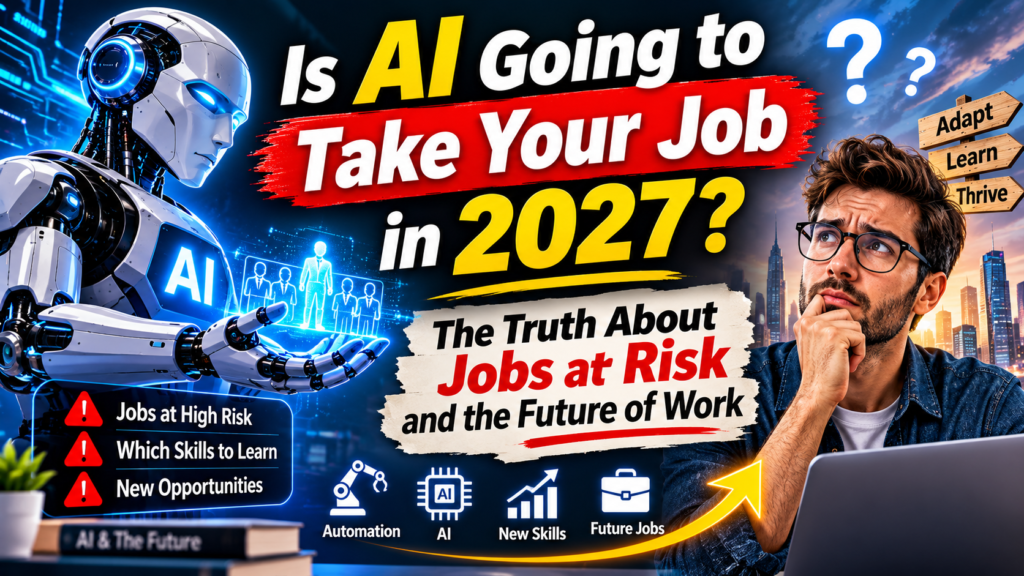
But as these technologies become more powerful, one important question is becoming harder to ignore: Is AI going to take your job in 2027?
The answer is not as simple as yes or no. AI is already capable of performing certain tasks that previously required human effort. Some jobs may face significant changes, while other professions could benefit from new opportunities created by artificial intelligence.
The important difference is that AI does not necessarily replace an entire profession. In many cases, it changes how people perform their work.
In this guide, we explore the jobs most exposed to AI, careers that could grow, the skills worth learning, and practical ways to prepare for the future of work.
1. Is AI Really Going to Take Your Job in 2027?

AI is unlikely to eliminate every job, but it is changing the tasks people perform.
For example, an employee who spends several hours preparing reports, organizing documents, creating presentations, or answering basic customer questions may now complete some of these tasks with AI assistance.
This does not automatically mean the entire position will disappear. Instead, the employee may need to focus more on reviewing information, making decisions, solving problems, and managing automated processes.
Research from the International Labour Organization (ILO), published in 2025, found that approximately one in four workers worldwide are in occupations with some exposure to generative AI.
However, the ILO explains that most jobs are more likely to be transformed than completely eliminated because many occupations still require human involvement.
The World Economic Forum’s Future of Jobs Report 2025 also projects that 170 million jobs could be created and 92 million displaced by 2030, resulting in a net increase of 78 million jobs.
These are projections, not guaranteed outcomes, and they reflect several economic and technological changes, not AI alone.
The main lesson is clear: AI is changing the value of different workplace tasks, and workers need to understand how those changes affect their professions.
2. Which Jobs Are Most at Risk From AI?
Jobs involving repetitive, predictable, and digitally processed tasks may experience greater pressure from automation.
Here are six examples:
1. Data Entry and Administrative Work
AI can extract information from documents, organize spreadsheets, process forms, and classify records. However, people are still needed to check information, manage unusual situations, and protect confidential records.
2. Basic Customer Support
AI chatbots can answer common questions, provide order updates, and explain simple procedures. More complicated complaints and sensitive conversations may still require human communication and judgment.
3. Basic Content Writing
AI can generate product descriptions, summaries, email drafts, and social media captions. However, research, original experience, interviews, fact-checking, and editorial judgment remain important.
4. Basic Graphic Design
AI image generators can create illustrations, advertising concepts, and social media graphics. Professional design still requires creative direction, brand understanding, and visual communication.
5. Transcription and Basic Translation
AI can convert speech into text, generate subtitles, and translate common phrases. Specialized legal, medical, technical, and culturally sensitive work requires careful review.
6. Repetitive Accounting Tasks
Financial software can categorize transactions, process invoices, and prepare basic summaries. Auditing, compliance, financial accountability, and professional decisions still require qualified oversight.
These examples show why it is important to distinguish between automating tasks and replacing entire professions.
3. Careers That Could Grow as AI Develops
AI is not only changing existing jobs. It is also creating demand for people who can develop, manage, secure, and use these technologies.
The World Economic Forum identifies several technology-related roles among the fastest-growing occupations expected through 2030.
Some careers worth watching include:
- AI specialists: Develop, implement, and evaluate artificial intelligence systems.
- Data analysts and data scientists: Transform information into useful business decisions.
- Cybersecurity professionals: Protect networks, information, and digital infrastructure.
- Robotics technicians: Install, maintain, and improve automated equipment.
- AI integration consultants: Help businesses introduce AI tools into their workflows.
- Digital marketing specialists: Combine AI-assisted research with marketing strategy and customer understanding.
Healthcare professionals and teachers may also benefit from AI-assisted tools that support administration, research, education, and everyday work.
However, these technologies do not remove the need for professional responsibility, communication, and human judgment.
4. AI Exposure Does Not Always Mean Job Replacement
One of the biggest misunderstandings about artificial intelligence is assuming that every occupation that uses AI will eventually disappear.
There is an important difference between AI exposure and AI automation.
AI exposure means that some tasks within a job could be performed or assisted by artificial intelligence.
AI automation means that a system can perform particular tasks with less direct human involvement.
Consider a marketing specialist.
AI may help this person research keywords, prepare advertising drafts, and summarize campaign data. However, the specialist still needs to understand customers, choose a strategy, approve the final message, and evaluate results.
The OECD also explains that greater exposure to AI does not automatically mean an occupation will be fully automated.
Instead of asking whether AI will replace your profession, ask this more useful question:
Which parts of my job can AI perform, and which skills will make my work more valuable?
5. The Most Important Skills to Learn Before 2027
You do not necessarily need to become a programmer or AI engineer to remain valuable in a changing job market.
Many professionals can benefit from combining technological knowledge with their existing experience.
Here are seven useful skills:
- AI literacy: Understand how AI works, what it can do, and where it makes mistakes.
- Critical thinking: Evaluate information instead of accepting every AI-generated answer.
- Communication: Improve writing, teamwork, negotiation, and professional communication.
- Creativity: Develop ideas and solutions that respond to real human needs.
- Data analysis: Learn how to interpret information and identify useful patterns.
- Problem-solving: Use technology to solve practical problems.
- Adaptability: Continue learning as tools and workplace requirements change.
The World Economic Forum’s 2025 report highlights analytical thinking, resilience, flexibility, creative thinking, AI and big data, and technological literacy among important skills for the coming years.
6. How to Prepare for AI Job Changes
You do not need to change your entire career overnight. Start with a few practical steps.
Step 1: Understand your current job.
List the tasks you perform every week. Identify which are repetitive, which AI could assist with, and which require human judgment or experience.
Step 2: Learn relevant AI tools.
Choose tools that solve problems in your profession instead of trying to learn every application available.
For example:
- Writers: ChatGPT and Grammarly.
- Designers: Canva and Adobe Firefly.
- Developers: GitHub Copilot.
- Data professionals: Microsoft Power BI.
- Business professionals: Microsoft Copilot.
Always review AI-generated results before using them professionally.
Step 3: Develop one additional skill.
A writer could learn SEO and research. A designer could improve branding skills. An administrator could learn workflow automation.
Combining professional experience with another useful skill can strengthen your career.
Step 4: Build real projects.
Create a website, design a marketing campaign, analyze a dataset, or automate a simple workflow.
Practical projects demonstrate your abilities better than simply watching tutorials.
Step 5: Continue learning.
Educational resources worth exploring include:
- Microsoft Learn
- Google AI Essentials
- IBM SkillsBuild
- Elements of AI
- Coursera
- Kaggle Learn
Check the terms of each platform because some courses and certificates may require payment.
7. What Does AI Mean for Workers in Developing Countries?
The impact of AI will not be identical everywhere.
Access to internet services, technology education, infrastructure, investment, and language support can influence how people benefit from artificial intelligence.
AI tools may create opportunities for freelancers, entrepreneurs, designers, developers, translators, and digital marketers to work with customers beyond their local markets.
For example, a small business may use AI to organize customer support and prepare marketing materials. A freelancer may use AI to improve research and productivity.
In countries such as Morocco, developing digital skills and supporting local innovation could help students, independent professionals, and businesses participate in the growing digital economy.
However, workers with limited access to technology and training may face additional challenges.
Access to education and opportunities to develop practical skills will be important during this transition.
8. Will AI Create More Jobs Than It Destroys?
The World Economic Forum projects that 170 million jobs could be created and 92 million displaced globally by 2030.
Although this suggests a potential net increase in employment, the transition will not benefit everyone equally.
Some workers may find new opportunities, while others may need to change occupations or learn different skills.
AI may create demand in areas such as:
- AI development and model evaluation.
- Data management and analysis.
- Cybersecurity.
- Robotics and automation.
- AI governance and compliance.
- AI training and implementation.
- Digital education and technology support.
The creation of new jobs does not automatically solve the challenges faced by people whose existing positions are changing.
Education, economic conditions, and access to retraining will all influence the outcome.
Conclusion: AI May Change Your Job, but You Can Prepare
So, is AI going to take your job in 2027?
Some workers will face serious disruption. Certain tasks will become automated, some professional roles will change, and businesses will reconsider how they organize their work.
At the same time, artificial intelligence will create opportunities for people who understand how to use these technologies effectively.
The most important lesson is not to compete with AI at everything it can do. Instead, develop the skills that help you use technology, evaluate its results, and provide value beyond automated output.
Learn continuously, improve your professional abilities, experiment with useful tools, and stay informed about changes in your industry.
The future of work will not only depend on who can use AI, but also on who knows how to question it, guide it, and turn it into something valuable.
Stay informed with Zawana Blog for more guides about artificial intelligence, digital technology, AI tools, and the future of work.
Frequently Asked Questions
1. Is AI going to take most jobs in 2027?
There is no reliable evidence that AI will eliminate most jobs by 2027. Research suggests that it will automate certain tasks and transform many occupations.
2. Which jobs are most exposed to AI?
Some data entry, basic administration, routine customer support, simple content production, and transcription tasks may face greater automation pressure.
3. What jobs are safer from AI?
No occupation is completely protected from technological change. Work involving human care, complex decisions, practical experience, and professional responsibility may be harder to automate fully.
4. Should I learn AI to protect my career?
Learning to use AI responsibly in your existing profession is a practical starting point.
5. Can AI replace software developers?
AI can generate code and help identify errors, but software development also requires system design, testing, security, and understanding user requirements.
6. Will AI replace teachers?
AI can support education, but teaching also involves understanding students, motivating learners, and developing critical thinking.
7. Are AI-related careers worth considering?
AI development, data science, cybersecurity, and AI integration are areas worth exploring. Actual opportunities depend on experience, location, and employer demand.
8. How can beginners prepare for AI?
Start with basic AI literacy, experiment with an AI assistant, verify its answers, and learn one additional skill related to your profession.




1 comment
Join the conversationMentioned elsewhere
Pingback: AI Coding Assistants: Claude Code, Cursor & Copilot